
Onsite Search Specialist - EMEA & LATAM
As an internal search specialist for Latin America and EMEA, I was responsible for reversing the decline in internal search KPIs on HP's e-commerce platforms. This project shows how I defined a flexible, data-driven optimisation framework and implemented specific actions to improve search relevance and conversion.
Team size:
5 (Global Onsite Search Team)
Main role:
Ecommerce Onsite Search Specialist LATAM & EMEA
Project Duration:
3 years
The Challenge
Key performance indicators (KPIs) for internal search relevance were starting to decline across multiple HP Stores in LATAM and EMEA. Local stakeholders began to express concerns about losing visibility and control over this key conversion touchpoint.
The Solution
In the absence of a unified methodology, my first step was to define the business levers that could improve YoY KPIs. I designed and deployed an adaptable action plan focused on maximizing relevance and usability of the onsite search engine while aligning closely with the migration roadmap to Magento.
Tool Used
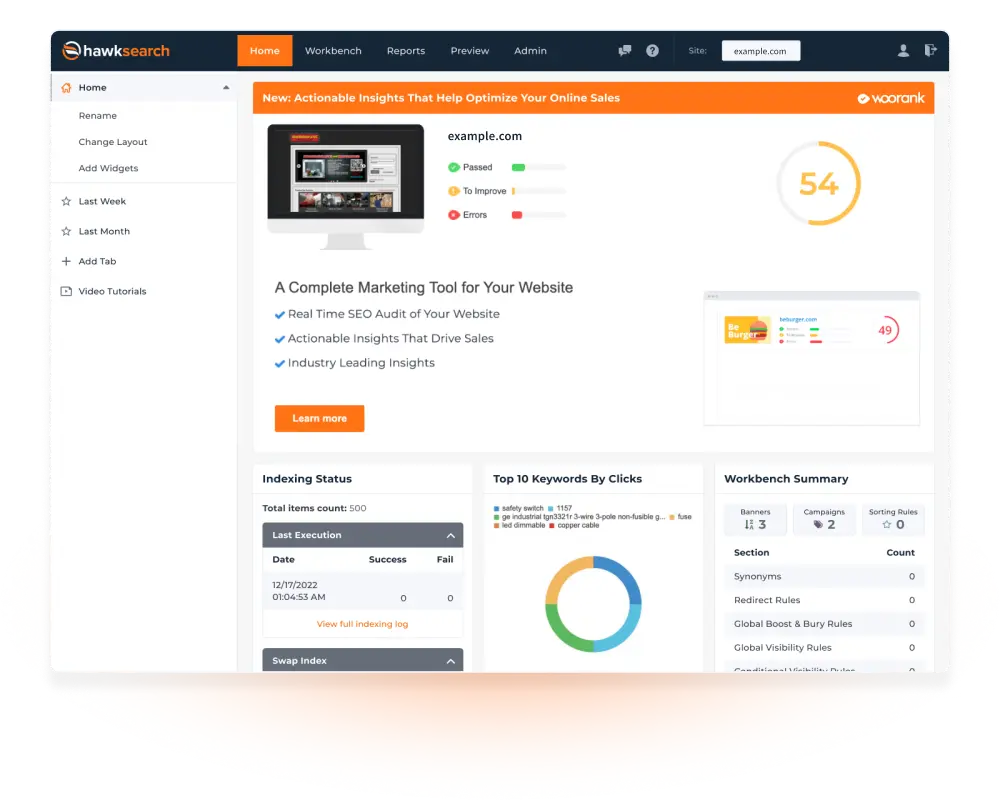
Hawksearch allowed custom rule sets, dynamic re-ranking based on behavioral data, and visual merchandising for search results.
Core Initiatives Across LATAM & EMEA
A. Relevance improvements
Developed a "Urgency vs. Impact" prioritization matrix to quickly identify high-leverage actions.
- Noise reduction in search results:
Removed non-matching or irrelevant items from high-volume queries using a weekly performance-based keyword list. Actions were driven by search term fluctuations and KPIs such as CTR, CVR, and Exit Rate.
- Boosting for underperforming high-volume generic keywords:
For terms with low CVR, best-selling items were boosted or pinned manually. - Zero-result mitigation:
Identified high-volume queries returning 0 results and applied keyword replacement rules. - Faceted re-ranking:
Enabled automatic facet re-ranking based on real-time user interactions. Closed unnecessary facets to slightly improve page load time. - Supportive banners and redirects:
Added banners triggered by support-related keywords to reduce bounce rate and guide users. - Boosting rule alignment with product attributes:
Adjusted generic rules to favor top-performing product configurations.
B. Optimization & UX Enhancements
Autocomplete suggestions optimization:
High-CVR keywords were added to autocomplete while low-performing suggestions were removed.Search-based campaign support:
Created campaign-specific banners to promote bundles or direct users to targeted offers.Boosting rules for promotional product sets:
Selected ~400 campaign products, grouped by category, and created keyword-specific and general boosting layers.Ongoing UX improvements post-launch:
Collaborated with UX and frontend teams to iterate search interface improvements based on heatmaps and user feedback.Delta indexing refinement:
Improved indexing schedules to reduce latency for product updates and availability changes.
Additional Strategic Actions
Traffic cleansing:
Identified and eliminated bot/referral traffic inflating search metrics. Some campaigns were driving traffic directly to search result pages, triggering false positives.
Automated reporting dashboards:
Built and distributed region-specific Looker Studio dashboards to key stakeholders, allowing self-service monitoring of trends and impact.
Cross-Regional Balance
- Established internal benchmarks to compare LATAM and EMEA search performance.
- Adapted best practices from LATAM mature markets to EMEA rollout.
- Built a shared documentation system of all configuration and rules used to ensure cross-region scalability.
Next Steps
Explore AI-powered search enhancements using intent prediction and semantic matching to further elevate relevance.
Expand personalization initiatives: integrate user behavior and purchase history to serve dynamic search experiences.
Scale the optimization framework to additional markets (e.g., APAC), incorporating lessons learned from LATAM and EMEA.
Extend campaign-driven search strategies by integrating onsite search with paid media triggers and onsite experiments.
Build a comprehensive search playbook with step-by-step optimization checklists, stakeholder handover docs, and training modules for regional teams.
Implement continuous A/B testing on search UX components (filters, autocomplete, banners) to iterate based on real user interactions.
The Results
The search optimization roadmap delivered tangible business impact across LATAM and EMEA, boosting user engagement, reducing friction in the search journey, and supporting multi-million–euro monthly operations
%
Conversion Rate (Q2 2025 YoY - EMEA)
%
Autocomplete Conversion Rate (2025 YoY - EMEA)
Tickets Resolved
Search-Driven Activity Managed per Month
%