
The Base Rate Fallacy
When Details Cloud the Real Probability
Summary
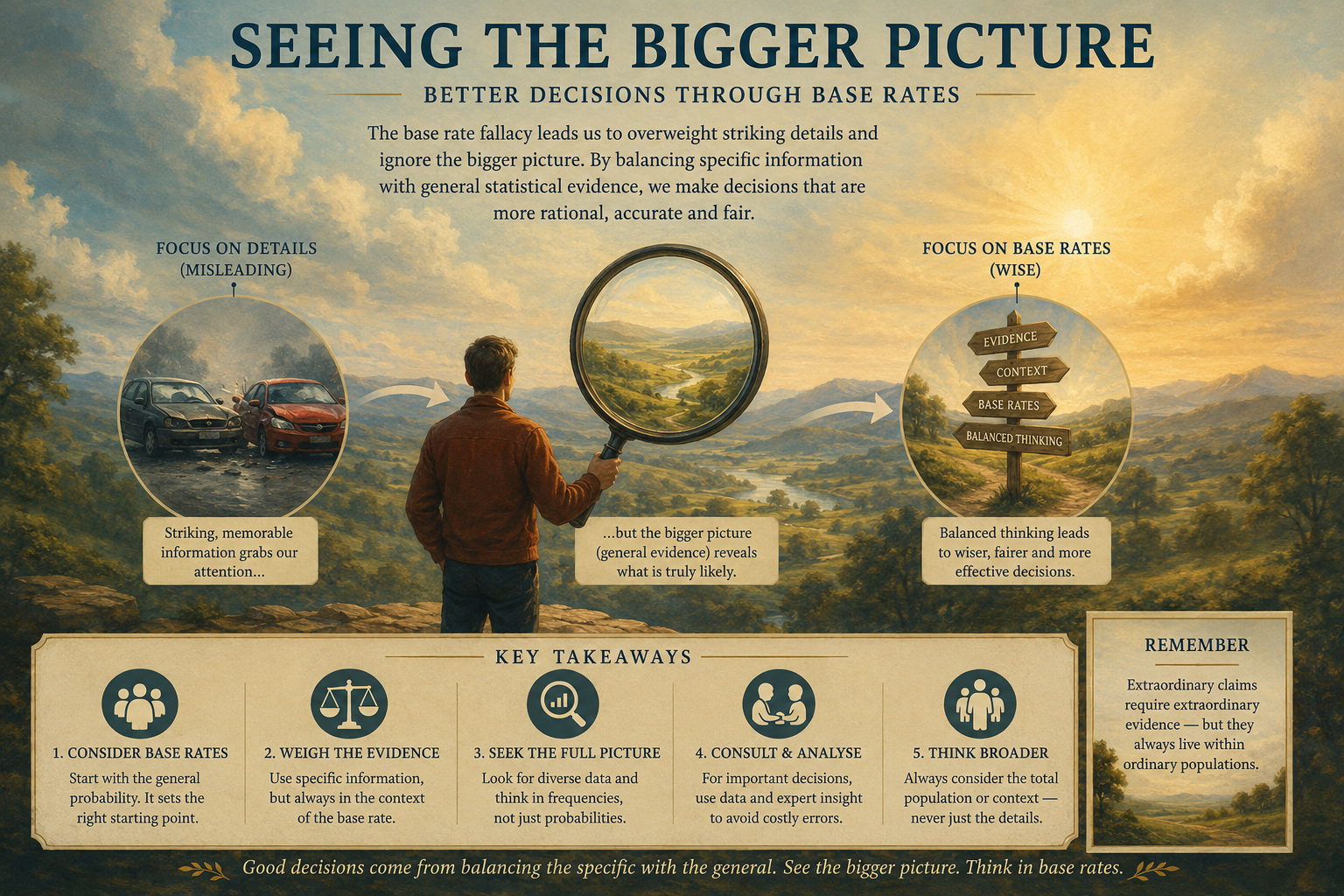
The base rate fallacy is a common reasoning error in which we ignore the overall probability of an event — the base rate — and instead place too much weight on specific or anecdotal information. This bias leads to mistaken conclusions across fields as different as medicine, law and business, where detailed information tends to feel more relevant than how often something actually occurs in the wider population.
Understanding this fallacy is essential to making better-informed decisions and to avoiding judgements built on striking but statistically insignificant details.
Introduction: The Curious Case of the Almost-Certain Diagnosis
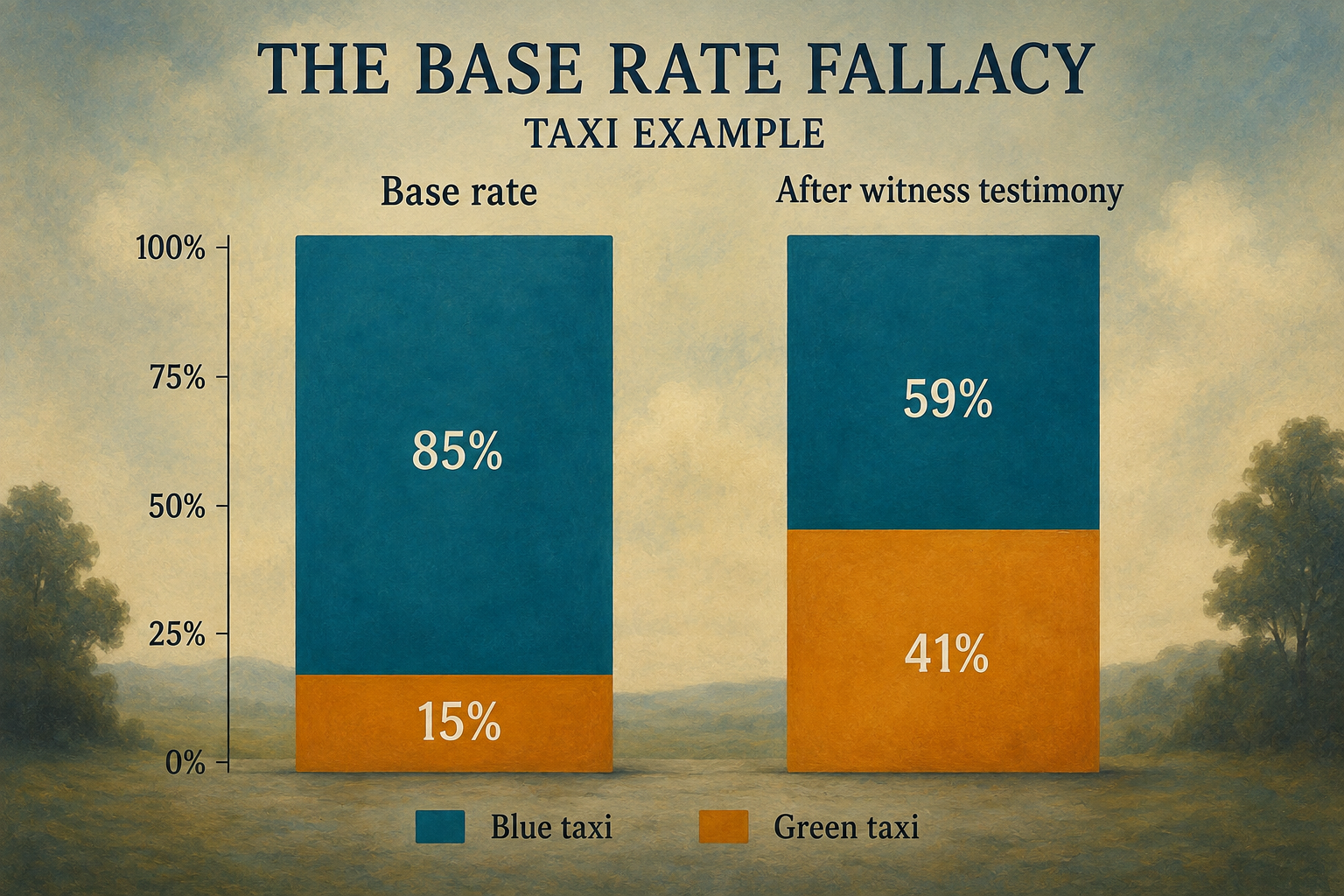
Picture an ordinary night in a city served by two taxi companies: Blue, which operates 85% of the vehicles, and Green, which operates the remaining 15%. A taxi is involved in a hit-and-run. A witness states that they saw a Green taxi fleeing the scene. Aware that visibility at night can be deceptive, the police test the witness under conditions similar to those on the night of the accident. The results show that the witness identifies the colour of the taxi correctly 80% of the time and gets it wrong the other 20% 1.
Presented with this information, most people asked how likely it is that the taxi involved was in fact Green will intuitively answer 80%, reasoning directly from the witness's accuracy. That answer, however plausible it sounds, overlooks one crucial piece of information: the proportion of Blue and Green taxis on the road. Applying Bayes' theorem reveals that the real probability the taxi was Green is considerably lower, close to 41% 1. This gap between intuition and statistical reality is the heart of the base rate fallacy: our tendency to overvalue specific information and to underweight the general prevalence, or prior probability, of an event. The purpose of this article is to unpack that reasoning error and to explore how understanding it leads to better-informed and more effective decisions across domains, from recruitment to medicine and the law.
Decoding the Base Rate Fallacy: Why We Ignore the Odds
The base rate fallacy, also known as base rate neglect or base rate bias 4, describes our inclination to disregard general statistical information — the base rate, or prior probability 5 — in favour of specific, individuating details about a particular case 4. In essence, when we are given both general and specific information, we tend to give far more weight to the latter, often discarding the former entirely.
Two simple analogies make the effect clearer. Imagine a large football stadium in which 1% of those present are doctors 5. Suddenly we see someone in a white coat carrying a stethoscope 5. Our first reaction might be: "That must be a doctor!" The specific information (the coat and the stethoscope) does point that way, but the base rate tells us that out of every 100 people in the stadium, only one is likely to be a doctor. The person in the coat could be an actor, a researcher, or simply someone in costume 5. Specific information is vivid; the general probability is more accurate.
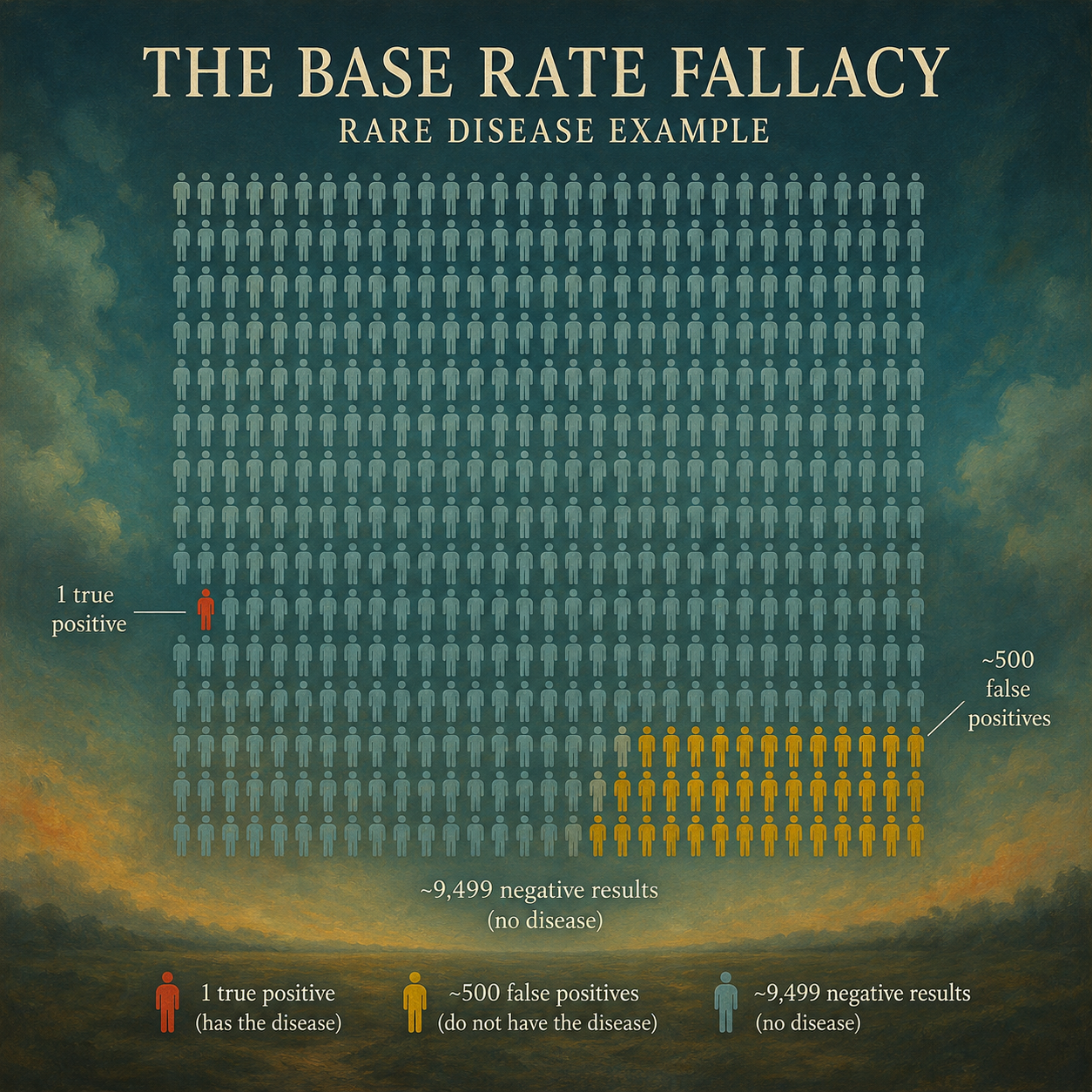
A second illustration comes from medicine. Suppose there is a test for a rare disease affecting 1 in 10,000 people 4, and the test is 95% accurate 4. Someone who tests positive may well assume they probably have the disease. Yet even with a highly accurate test, the low base rate means a positive result is far more likely to be a false alarm 4. Out of 10,000 people, only one will have the disease. Applied to the 9,999 healthy people, the test will produce roughly 500 false positives — 5% of 9,999. A positive result is therefore far more likely to be a false alarm than a genuine indication of disease 4. Both analogies show how the base rate fallacy leads to wrong conclusions when the underlying probability of events goes unconsidered.
The Base Rate Fallacy in Everyday Life: Practical Examples
The base rate fallacy is not merely an abstract concept. It surfaces in ordinary and professional situations alike, shaping decisions in ways that are subtle but consequential.
In business and human resources, the fallacy distorts recruitment. Picture a hiring manager looking for a marketing specialist. Hundreds of CVs arrive, and one stands out because it mentions a prestigious university and an internship at a well-known company 8. The manager may immediately favour that candidate, overlooking the base rate of successful marketing specialists who come from a wide range of backgrounds and experiences, and passing over candidates with less glamorous CVs but potentially stronger skills or a better fit with the company's culture 8. The pull of prestige and recognisable brands easily eclipses the real probability of a candidate succeeding, which rests on more relevant factors such as skill and experience. Indeed, some research suggests interviews are overvalued in university admissions, since interviewers routinely fail to beat the predictive power of basic statistics 4.
In medicine, the fallacy leads to misread test results. Consider a patient who tests positive for a rare genetic marker associated with a slightly elevated risk of a specific disease — a low base rate. The test has high sensitivity and specificity. Both patient and physician, if they are not careful, may overestimate the likelihood that the patient will actually develop the disease, generating unnecessary anxiety or prompting aggressive intervention. They focus on the positive result and neglect the low prevalence of the disease in the population. Research has shown that even experienced physicians struggle to interpret probabilities correctly in diagnostic scenarios 9. A positive test result, though specific, can cause disproportionate alarm and lead to unnecessary procedures when the low base rate of the condition is not properly weighed.
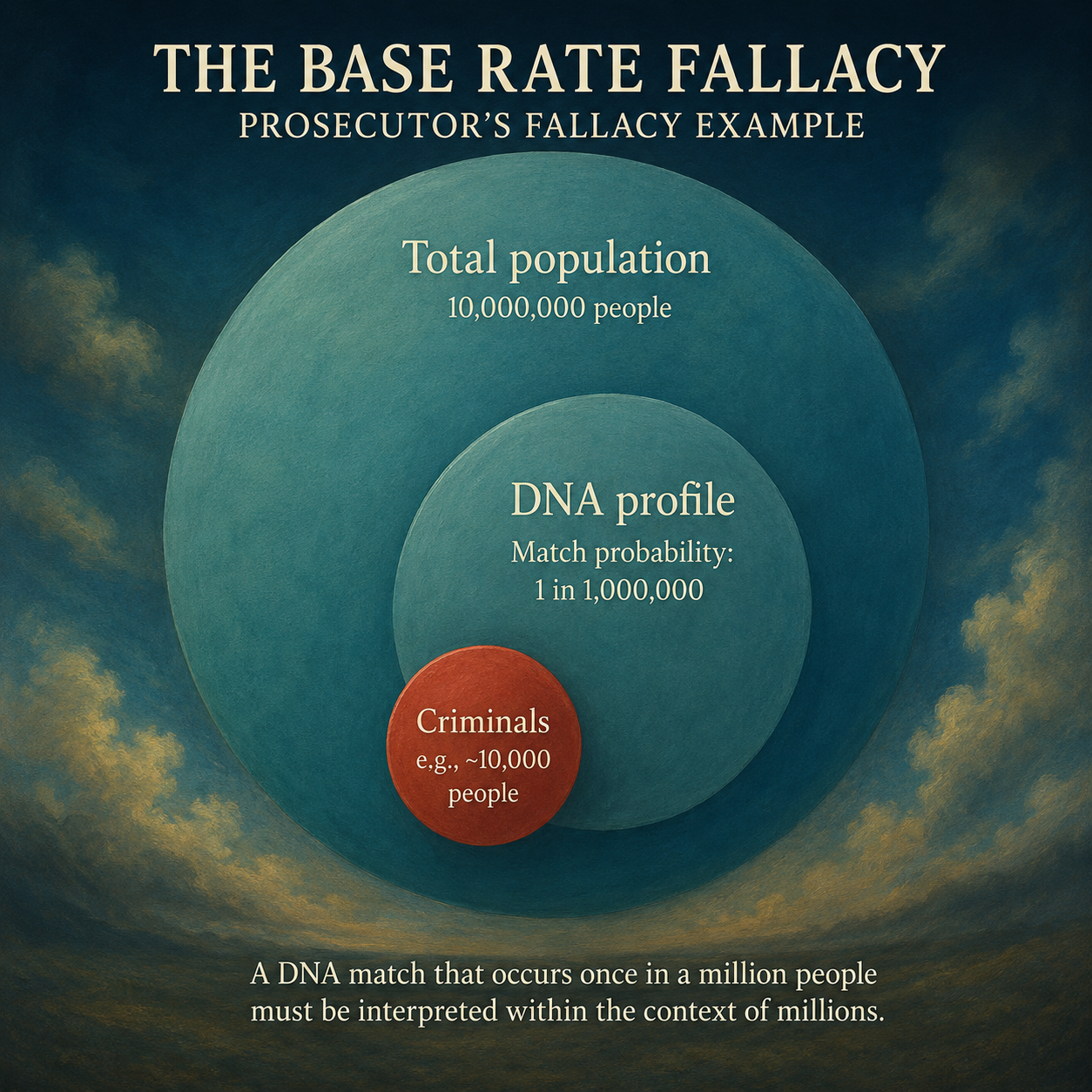
In the justice system, the consequences can be severe, up to and including wrongful conviction. The classic example involves DNA evidence. If DNA from a crime scene matches a suspect identified in a large database — say, with a one-in-a-million probability of a random match — a prosecutor may argue that there is therefore only a one-in-a-million chance that the suspect is innocent. This is the prosecutor's fallacy 4. It ignores the base rate of innocent people in the population who could share that rare profile: in a city of several million, more than one person may carry it. A second example is the O.J. Simpson trial, where the defence argued that only about 1 in 2,500 battered women are murdered by their partner, and that a history of abuse was therefore weak evidence of guilt. The argument is fallacious because it invokes the wrong base rate. The relevant question is not how often a battered woman is murdered, but how often a battered woman who has in fact been murdered was killed by her abuser — a figure closer to 80% 4. Misreading statistical evidence by neglecting the correct base rate can send innocent people to prison.
The Representativeness Trap: Why the Details Win
The base rate fallacy is closely bound up with another cognitive bias: the representativeness heuristic 3. This heuristic is the mental shortcut we use to judge how likely something is by asking how closely it resembles a typical example or stereotype we already hold 3.
Base rate neglect happens so often precisely because the specific details of a situation strike us as so "representative" of a category that we stop asking how common that category actually is 4. Take the shy librarian versus the salesperson. Told that someone is "shy and quiet", we are inclined to guess librarian rather than salesperson, because the description matches our stereotype of a librarian. What we overlook is that there are far more salespeople than librarians in the world 4. Our impression of the person better "represents" the image of a librarian, so we neglect the base rate of the two professions.
The "Tom W." experiment is another classic 25. Participants were given a brief personality sketch of an individual named Tom W. and asked to rank how likely he was to be enrolled in various graduate fields. They overwhelmingly favoured fields that seemed to match Tom's personality — computer science, for instance — over fields with far higher enrolment, such as education. Representativeness dominated the base rate. Rather than weighing the statistical likelihood that a student belongs to a much larger programme, participants leaned on the perceived similarity between Tom's description and the stereotype of a computer science student.
Mind the Cousins: Related Cognitive Biases
The base rate fallacy does not operate in isolation. It is related to other cognitive biases that also degrade our probabilistic reasoning.
The gambler's fallacy is the mistaken belief that past events in a sequence of independent events — coin tosses, for example — influence future probabilities 34. Although distinct from the base rate fallacy, the two are related in that both involve misreading the underlying probabilities of events over time.
Confirmation bias is our tendency to favour information that confirms our existing beliefs while discarding information that contradicts them 26. We may seek out specific information that confirms an initial judgement — potentially flawed through base rate neglect — and avoid the information that would challenge it.
The availability heuristic is the mental shortcut by which we assess the likelihood of an event based on how easily we can recall examples of it 21. Specific, vivid or recent examples can eclipse base rate information, which is usually less memorable but statistically more relevant.
Outsmarting Our Own Brain: Practical Strategies
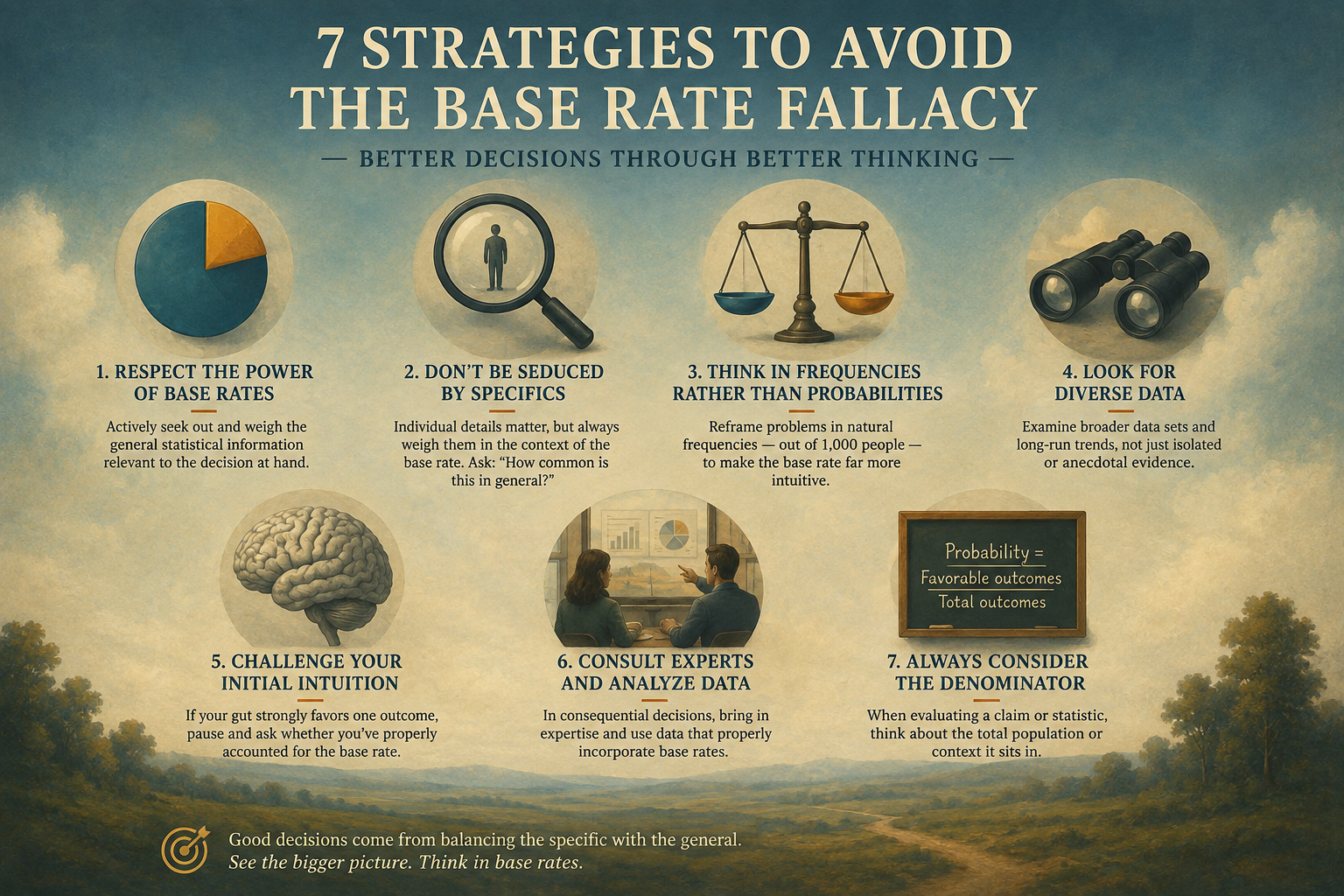
There are practical strategies for blunting the impact of the base rate fallacy and improving the quality of our decisions.
First, respect the power of base rates. Actively seek out and weigh the general statistical information relevant to the decision at hand 28.
Second, do not be seduced by specificity. Individual details matter, but they should always be weighed in the context of the base rate 25. The question to keep asking is: "How common is this in general?"
Third, wherever possible, think in frequencies rather than probabilities. Reframing a probability problem in terms of natural frequencies — "out of every 1,000 people..." — makes the base rate far more intuitive 4.
Fourth, look for diverse data. Rather than relying on limited or anecdotal evidence, examine broader data sets and long-run trends 28.
Fifth, challenge your initial intuition. If your gut strongly favours one outcome on the strength of specific details, stop and ask whether you have properly accounted for the base rate 25.
Sixth, on consequential decisions — in human resources, business strategy or medicine — consult experts and analyse data that take base rates into account 25.
Finally, always consider the denominator. When evaluating a specific claim or statistic, think about the total population or the wider context it sits in 49.
Conclusion: Seeing the Bigger Picture for Better Decisions
The base rate fallacy is a common cognitive error that can lead us badly astray in a wide range of situations. Recognising the tendency in our own thinking is the first step towards more rational, better-informed decisions, professionally and personally. By acknowledging the importance of base rates and working to balance specific information against general probability, we can avoid the trap of details that are striking but statistically misleading. In a world saturated with specific stories and compelling anecdotes, how do we deliberately build in the less glamorous but often more revealing power of base rates?
Visualising Probabilities
To illustrate the base rate fallacy more concretely, return to the rare disease with a prevalence of 1 in 10,000 and a test that is 95% accurate. We can represent this with an icon array. Imagine 10,000 icons standing for 10,000 people. Of these, a single icon represents the person with the disease. Applied across all 10,000, the test will return a positive result for roughly 5% of the healthy people, producing around 500 false positives (0.05 × 9,999 ≈ 500). So out of every batch of positive results, one will be a true positive and approximately 500 will be false. The visual makes plain why, even with an accurate test, a positive result is far more likely to be a false alarm when the base rate of the disease is low 4.
For the taxi problem, a bar chart works better, comparing the prior probabilities with the revised probabilities after the witness testimony. One set of bars shows the initial base rate: 85% Blue taxis and 15% Green. A second set shows the probabilities once the witness's accuracy is factored in (80% correct identification): roughly 59% that the taxi was Blue and 41% that it was Green. The comparison highlights what happens when both the base rate and the specific evidence — the testimony — are combined through a simplified application of Bayes' theorem.
Learning from History
The study of the base rate fallacy has a rich history in cognitive psychology, owing above all to the pioneering work of Daniel Kahneman and Amos Tversky 3. Their seminal research in the 1970s and afterwards identified and characterised the bias, showing how systematically people depart from normative probabilistic reasoning when deciding under uncertainty.
Its contemporary relevance is visible in how current statistics are read — for instance, those on COVID-19 vaccination 4. It is often reported that more hospitalised COVID-19 patients are vaccinated than unvaccinated. Taken out of context, that observation invites the mistaken conclusion that the vaccines do not work. The base rate fallacy is at play: in populations with high vaccination rates, it is statistically expected that most cases, hospitalisations and even deaths will occur among the vaccinated, simply because they make up a far larger share of the total population. Ignoring the base rate of vaccination produces badly misleading conclusions about vaccine effectiveness.
What the Experts Say
The ideas discussed here rest on a solid body of research in cognitive psychology and behavioural economics. Numerous studies have documented how widespread base rate neglect is and what it implies across decision-making domains.
The work of Gerd Gigerenzer 9 on risk literacy underlines how much depends on understanding base rates, particularly in high-stakes fields such as health and law. His research shows that presenting the same statistics as natural frequencies rather than conditional probabilities markedly improves how accurately people — physicians included — interpret diagnostic results 9, which is a practical route out of the tendency to ignore base rates in favour of specific information.
Works Cited
- A Classical Example of The Base Rate Fallacy - Cornell University, accessed: March 22, 2025, https://blogs.cornell.edu/info2040/2021/11/06/a-classical-example-of-the-base-rate-fallacy/
- THE BASE-RATE FALLACY IN PROBABILITY JUDGMENTS Consider the following problem, accessed: March 22, 2025, http://bear.warrington.ufl.edu/brenner/mar7588/Papers/barhillel-acta1980.pdf
- Representativeness heuristic - Wikipedia, accessed: March 22, 2025, https://en.wikipedia.org/wiki/Representativeness_heuristic
- Base rate fallacy - Wikipedia, accessed: March 22, 2025, https://en.wikipedia.org/wiki/Base_rate_fallacy
- Base rate - Wikipedia, accessed: March 22, 2025, https://en.wikipedia.org/wiki/Base_rate
- 3.7: The Base Rate Fallacy - Humanities LibreTexts, accessed: March 22, 2025, https://human.libretexts.org/Bookshelves/Philosophy/Introduction_to_Logic_and_Critical_Thinking_2e_(van_Cleave)/03%3A_Evaluating_Inductive_Arguments_and_Probabilistic_and_Statistical_Fallacies/3.07%3A_The_Base_Rate_Fallacy
- What Is Base Rate Fallacy? | Definition & Examples - QuillBot, accessed: March 22, 2025, https://quillbot.com/blog/reasoning/base-rate-fallacy/
- Examples Of The Base Rate Fallacy - FasterCapital, accessed: March 22, 2025, https://fastercapital.com/topics/examples-of-the-base-rate-fallacy.html
- Reckoning with Risk: Learning to Live with Uncertainty - PMC, accessed: March 22, 2025, https://pmc.ncbi.nlm.nih.gov/articles/PMC1124884/
- Reckoning With Risk: Learning to Live With Uncertainty | Request PDF - ResearchGate, accessed: March 22, 2025, https://www.researchgate.net/publication/27282348_Reckoning_With_Risk_Learning_to_Live_With_Uncertainty
- A systematic account of probabilistic fallacies in legal fact-finding - Christian Dahlman, 2024, accessed: March 22, 2025, https://journals.sagepub.com/doi/full/10.1177/13657127231209019
- Avoiding Probabilistic Reasoning Fallacies in Legal Practice using Bayesian Networks - School of Electronic Engineering and Computer Science, accessed: March 22, 2025, https://www.eecs.qmul.ac.uk/~norman/papers/fenton_neil_prob_fallacies_3_July_09.pdf
- Avoiding Probabilistic Reasoning Fallacies in Legal Practice using Bayesian Networks - CiteSeerX, accessed: March 22, 2025, https://citeseerx.ist.psu.edu/document?repid=rep1&type=pdf&doi=41cc188840f62df42b91a1ebad049a82c808c1b7
- Avoiding Probabilistic Reasoning Fallacies in Legal Practice using Bayesian Networks - School of Electronic Engineering and Computer Science, accessed: March 22, 2025, https://www.eecs.qmul.ac.uk/~norman/papers/fenton_neil_prob_fallacies_June2011web.pdf
- Epidemiology Visualized: The Prosecutor's Fallacy - Oxford Academic, accessed: March 22, 2025, https://academic.oup.com/aje/article/179/9/1125/103523
- Bayes' Theorem in the Court – the Prosecutor's Fallacy - Cornell blogs, accessed: March 22, 2025, https://blogs.cornell.edu/info2040/2018/11/28/bayes-theorem-in-the-court-the-prosecutors-fallacy/
- The Prosecutor's Fallacy - TOM ROCKS MATHS, accessed: March 22, 2025, https://tomrocksmaths.com/2021/09/08/the-prosecutors-fallacy/
- Fallacies, accessed: March 22, 2025, https://si.biostat.washington.edu/sites/default/files/modules/6.3%20Fallacies.pdf
- The Prosecutor's Fallacy - YouTube, accessed: March 22, 2025, https://www.youtube.com/watch?v=E3VoTTR8MXM
- Base Rate Fallacy, accessed: March 22, 2025, https://www.logicallyfallacious.com/logicalfallacies/Base-Rate-Fallacy
- Understanding the Base Rate Fallacy: How Our Biases Can Mislead Our Reasoning, accessed: March 22, 2025, https://www.tajucoaching.com/blog/understanding-base-rate-fallacy-how-our-biases-can-mislead-our-reasoning
- Prosecutor's Fallacy: Definition, Formula & Examples | Engineering Maths - GeeksforGeeks, accessed: March 22, 2025, https://www.geeksforgeeks.org/prosecutors-fallacy/
- Prosecutor's Fallacy and Base Rate Fallacy - To Summarise, accessed: March 22, 2025, https://www.tosummarise.com/prosecutors-fallacy-and-base-rate-fallacy/
- The Prosecutor's Fallacy - Centre for Evidence-Based Medicine - University of Oxford, accessed: March 22, 2025, https://www.cebm.ox.ac.uk/news/views/the-prosecutors-fallacy
- Base Rate Fallacy - The Decision Lab, accessed: March 22, 2025, https://thedecisionlab.com/biases/base-rate-fallacy
- Decision-Making - Free Sketchy MCAT Lesson, accessed: March 22, 2025, https://www.sketchy.com/mcat-lessons/decision-making
- Representativeness Heuristic | Example & Definition - Scribbr, accessed: March 22, 2025, https://www.scribbr.com/research-bias/representativeness-heuristic/
- What Is Base Rate Fallacy? | Definition & Examples - Scribbr, accessed: March 22, 2025, https://www.scribbr.com/fallacies/base-rate-fallacy/
- Representativeness Heuristic | Examples & Definition - QuillBot, accessed: March 22, 2025, https://quillbot.com/blog/bias/representativeness-heuristic/
- Representativeness Heuristic – Everything You Need to Know - InsideBE, accessed: March 22, 2025, https://insidebe.com/articles/representativeness-heuristic/
- How the Representativeness Heuristic Affects Decisions and Bias - Verywell Mind, accessed: March 22, 2025, https://www.verywellmind.com/representativeness-heuristic-2795805
- Representativeness Heuristic: Definition & Examples - Statistics By Jim, accessed: March 22, 2025, https://statisticsbyjim.com/basics/representativeness-heuristic/
- Base Rate Fallacy : Taking Informed Decisions Amidst Uncertainty | by Iris John - Medium, accessed: March 22, 2025, https://medium.com/@irisjohn/base-rate-fallacy-taking-informed-decisions-amidst-uncertainty-dea11897f466
- List of fallacies - Wikipedia, accessed: March 22, 2025, https://en.wikipedia.org/wiki/List_of_fallacies
- Financial Fallacies Explained: The Hot Hand Fallacy and the Gambler's Fallacy - Hartford Funds, accessed: March 22, 2025, https://www.hartfordfunds.com/insights/investor-insight/investor-behavior/financial-fallacies-explained.html
- Gambler's Fallacy: Overview and Examples - Investopedia, accessed: March 22, 2025, https://www.investopedia.com/terms/g/gamblersfallacy.asp
- Gambler's fallacy - Wikipedia, accessed: March 22, 2025, https://en.wikipedia.org/wiki/Gambler%27s_fallacy
- Gambler's fallacy - The Decision Lab, accessed: March 22, 2025, https://thedecisionlab.com/biases/gamblers-fallacy
- Gambler's Fallacy: Overview & Examples - Statistics By Jim, accessed: March 22, 2025, https://statisticsbyjim.com/basics/gamblers-fallacy/
- List of cognitive biases - Wikipedia, accessed: March 22, 2025, https://en.wikipedia.org/wiki/List_of_cognitive_biases
- Base Rate Fallacy: Ignoring General Information in Favor of Specifics - Renascence, accessed: March 22, 2025, https://www.renascence.io/journal/base-rate-fallacy-ignoring-general-information-in-favor-of-specifics
- Confirmation bias | Definition, Examples, Psychology, & Facts | Britannica, accessed: March 22, 2025, https://www.britannica.com/science/confirmation-bias
- Confirmation bias - Wikipedia, accessed: March 22, 2025, https://en.wikipedia.org/wiki/Confirmation_bias
- Cognitive Bias: Base Rate Fallacy - Neuroprofiler, accessed: March 22, 2025, https://neuroprofiler.com/en/base-rate-allacy/
- Base Rate Fallacy - Cognitive Distortion - Thinking Bugs, accessed: March 22, 2025, https://thinkingbugs.com/base-rate-fallacy
- Availability heuristic - Wikipedia, accessed: March 22, 2025, https://en.wikipedia.org/wiki/Availability_heuristic
- Base Rate Fallacy: Definition, Examples, and Impact - Simply Psychology, accessed: March 22, 2025, https://www.simplypsychology.org/base-rate-fallacy.html
- Availability Heuristic - The Decision Lab, accessed: March 22, 2025, https://thedecisionlab.com/biases/availability-heuristic
- Base Rate Fallacy - The Uncertainty Project, accessed: March 22, 2025, https://www.theuncertaintyproject.org/bias/base-rate-fallacy
- How can you avoid the base rate fallacy? - QuillBot, accessed: March 22, 2025, https://quillbot.com/blog/frequently-asked-questions/how-can-you-avoid-the-base-rate-fallacy/
- Base Rate Fallacy Overview & Examples - Statistics By Jim, accessed: March 22, 2025, https://statisticsbyjim.com/probability/base-rate-fallacy/
- Reckoning with Risk by Gerd Gigerenzer | Shakespeare & Company, accessed: March 22, 2025, https://www.shakespeareandcompany.com/books/reckoning-with-risk
- Reckoning with Risk: Learning to Live with Uncertainty: Gigerenzer, Gerd - Amazon.com, accessed: March 22, 2025, https://www.amazon.com/Reckoning-Risk-Learning-Live-Uncertainty/dp/0140297863
- Reckoning with risk: learning to live with uncertainty | British Journal of Sports Medicine, accessed: March 22, 2025, https://bjsm.bmj.com/content/37/1/92.3
- Reckoning with Risk: Learning to Live with Uncertainty by Gerd Gigerenzer | Goodreads, accessed: March 22, 2025, https://www.goodreads.com/book/show/320406
- Biomedical nerdview - Language Log, accessed: March 22, 2025, https://languagelog.ldc.upenn.edu/nll/?p=14835
- Base-rate respect: From ecological rationality to dual processes - Decision Neuroscience Laboratory, accessed: March 22, 2025, https://decisionneurosciencelab.org/pdfs/Barbey%20&%20Sloman%20(2007).pdf