
The Frame Game
How the Way You See Things Changes Everything You Do
Summary
The article explores the Framing Effect, a powerful cognitive bias in which the way information is presented—whether as a gain or a loss—can significantly alter our decisions, even when the facts remain the same. From everyday shopping to life-or-death medical choices, how options are framed influences risk preferences, emotional reactions, and judgments. Grounded in Prospect Theory and loss aversion, the effect reveals our brain’s tendency to prioritize emotional and efficient decision-making over analytical reasoning.
Through real-world examples in marketing, HR, medicine, and justice, the article highlights the ethical and practical importance of recognizing, resisting, and using framing consciously to foster more objective and responsible choices.
Imagine you're shopping for a new jacket. You find one you like, available in two different scenarios. In Scenario A, the jacket costs $100. In Scenario B, the exact same jacket is priced at $200, but it's currently advertised with a prominent "50% Off!" tag, bringing the price down to $100. Logically, the cost is identical. Yet, for many people, Scenario B feels like a much better deal, perhaps even prompting a quicker purchase.[1] Why does a simple change in presentation make such a difference?
This isn't just a clever sales tactic; it reveals a fundamental quirk in human psychology known as the Framing Effect. It's a cognitive bias demonstrating that the way information is presented—the "frame" around the facts—can dramatically influence our perceptions, judgments, and ultimately, the choices we make, even when the underlying reality remains unchanged.[1] The power of framing isn't confined to shopping decisions; it operates subtly but significantly in high-stakes situations, influencing outcomes that can have profound consequences.
Consider the classic thought experiment devised by psychologists Amos Tversky and Daniel Kahneman, pioneers in identifying this bias.[22] Imagine the U.S. is preparing for the outbreak of an unusual Asian disease, expected to kill 600 people. Two alternative programs to combat the disease are proposed, with identical outcomes but different descriptions [3]:
Positive Frame (Saving Lives):
- Program A: "200 people will be saved." (Certain gain)
- Program B: "There is a 1/3 probability that 600 people will be saved, and a 2/3 probability that no people will be saved." (Risky gain)
Negative Frame (People Dying):
- Program C: "400 people will die." (Certain loss)
- Program D: "There is a 1/3 probability that nobody will die, and a 2/3 probability that 600 people will die." (Risky loss)
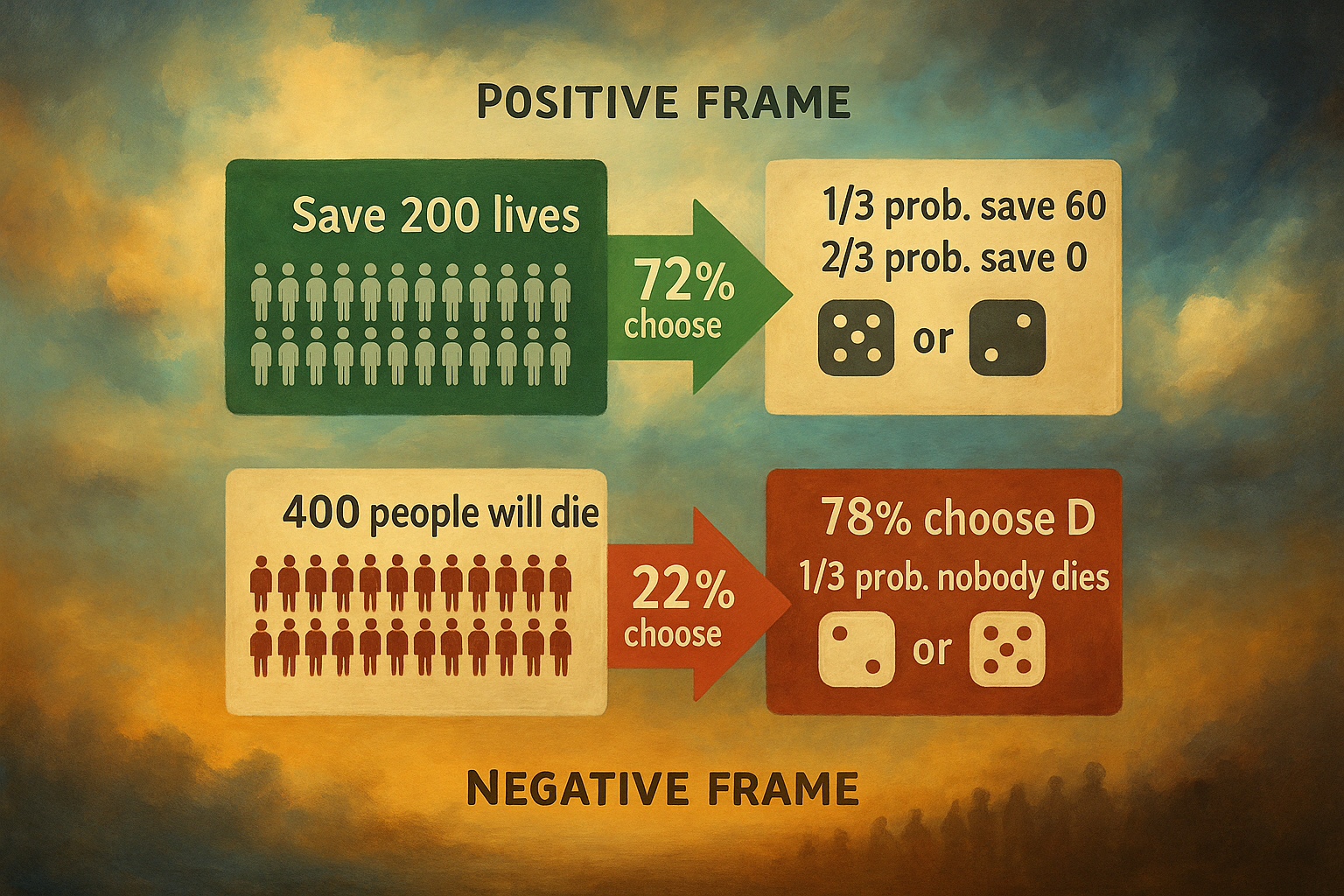
Logically, Program A and Program C are identical (200 saved means 400 die), as are Program B and Program D. Yet, the way the choices were framed led to a dramatic reversal in preference. When presented with the positive frame (saving lives), a strong majority (72%) chose the certain Program A. However, when faced with the negative frame (people dying), only 22% chose the certain Program C (the same option as A); instead, the majority opted for the risky Program D.[7] This striking result highlights that even life-and-death decisions can be swayed purely by the wording used, demonstrating the potent and often unseen influence of framing.[3]
Understanding the Framing Effect is crucial, particularly for professionals in leadership, HR, marketing, and any field involving decision-making and communication. It affects how we evaluate candidates, respond to marketing messages, negotiate deals, manage finances, and even perceive policy choices. This article delves into what the Framing Effect is, the psychological mechanisms behind it, its real-world manifestations in recent years, its connection to other cognitive biases, and most importantly, practical strategies to help navigate its influence and make clearer, more objective choices.
What is the Framing Effect? Seeing the Same Picture Differently
At its core, the Framing Effect is a cognitive bias where our decisions are swayed by the manner in which information or options are presented—the "frame"—rather than solely by the objective facts themselves.[3] Think of the classic "Is the glass half full or half empty?" dilemma.[2] The amount of water is the same, but the description evokes a different feeling or perspective. The Framing Effect operates similarly, showing that our choices often depend more on the perception created by the frame than on the substance within it.
This phenomenon represents a violation of a fundamental principle of rational decision-making known as description invariance or extensionality.[3] This principle states that if two problems or options are logically equivalent, they should elicit the same preference, regardless of how they are described. However, the Framing Effect consistently demonstrates that this isn't how the human mind always works.[3] As Nobel laureate Daniel Kahneman noted, "Unless there is an obvious reason to do otherwise, most of us passively accept decision problems as they are framed and therefore rarely have an opportunity to discover the extent to which our preferences are frame-bound rather than reality-bound".[41] We often don't realize that the seemingly innocuous way information is presented is subtly steering our judgment by manipulating the reference point against which we evaluate the options.[31]
The most widely studied and perhaps most intuitive type of framing involves Gain versus Loss Framing. This highlights a consistent pattern in human risk preference:
- When options are framed as potential GAINS: We tend to become risk-averse. We prefer a smaller, guaranteed gain over a larger, uncertain gain. In the Asian Disease Problem, choosing Program A ("Save 200 lives") reflects this preference for certainty when the outcome is framed positively.[3]
- When options are framed as potential LOSSES: We tend to become risk-seeking. We prefer to take a gamble with the possibility of avoiding any loss, even if it means risking a larger loss, rather than accept a smaller, guaranteed loss. In the Asian Disease Problem, choosing Program D (the risky option where 400 people dying is not certain) over Program C ("400 people will die") illustrates this shift towards risk when the outcome is framed negatively.[3]
This gain/loss dynamic plays out in countless everyday situations, often influencing our choices without conscious awareness:
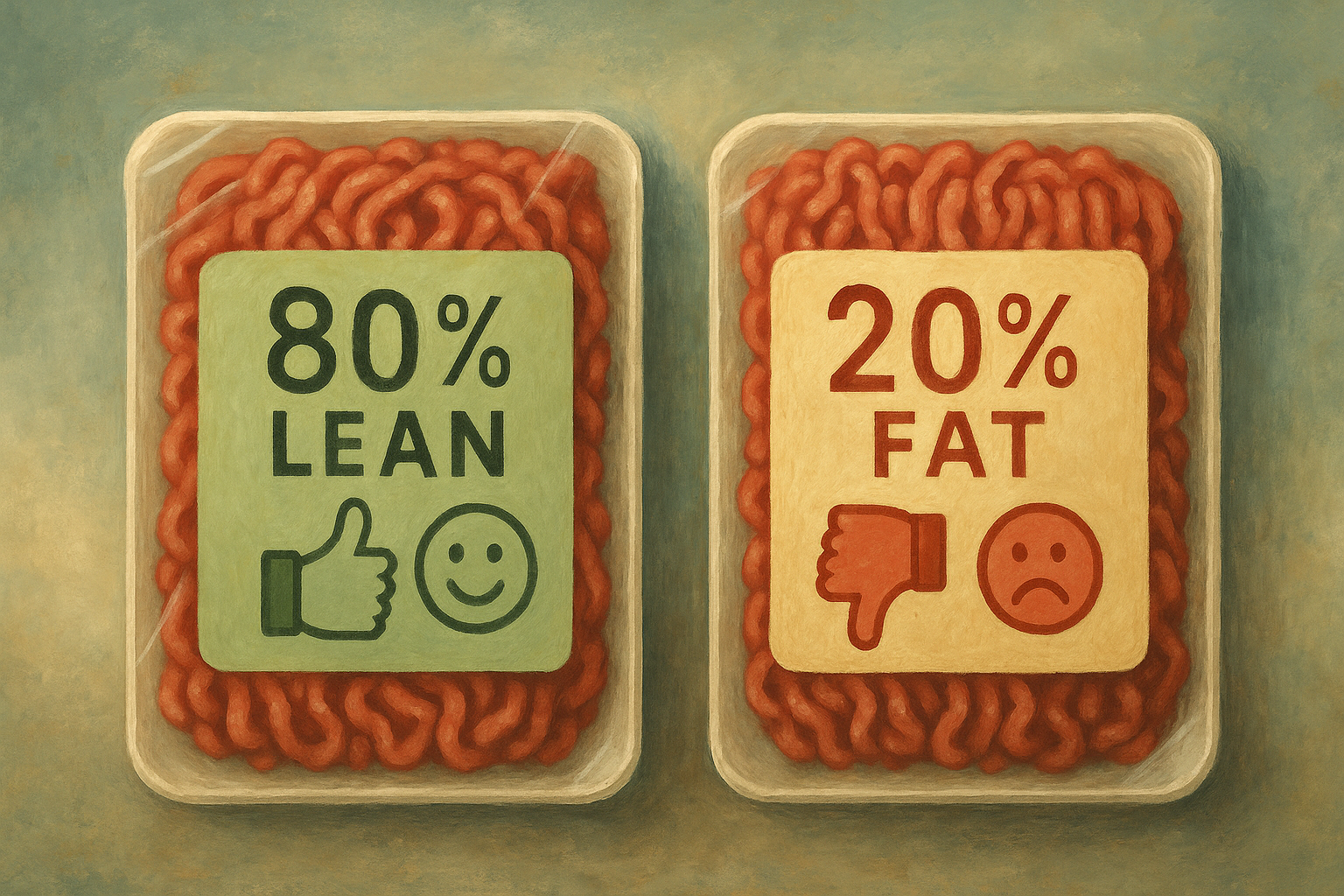
- Meat Labeling: Ground beef labeled "80% lean" is consistently rated as tasting better and being of higher quality than the exact same meat labeled "20% fat".1 The positive frame ("lean") is simply more appealing than the negative frame ("fat").
- Condom Effectiveness: A condom advertised as "95% effective" sounds more reassuring and is generally preferred over one described with a "5% failure rate," despite conveying identical statistical information.[3]
- Disinfectant Claims: A wipe that "kills 95% of germs" is perceived more favorably than one where "only 5% of germs survive," even though the effectiveness is the same.[4]
While gain/loss framing is the most common, the effect extends to other types of presentation manipulation:
- Attribute Framing: This involves highlighting a single characteristic of an object or situation in either a positive or negative light. The meat labeling example also falls under this category, as it focuses solely on the leanness/fat attribute.[3]
- Goal Framing: This type focuses on the consequences of performing or not performing a certain action. It emphasizes either the benefits achieved by acting (positive goal frame) or the negative outcomes avoided by acting (negative goal frame, often leveraging loss aversion). An example is charging a "late registration penalty" versus offering an "early registration discount"—the penalty frame often proves more motivating for timely action.[3] Health campaigns frequently use goal framing, highlighting either the benefits of healthy behavior or the risks of unhealthy behavior.[4]
Crucially, the Framing Effect isn't limited to choices involving risk. As the meat labeling example shows, it influences our evaluations, perceptions of quality, and overall appeal even when the decision doesn't involve a gamble.[3] This broad applicability makes understanding framing essential for navigating the myriad of messages and choices encountered in the business world and beyond.
Framing in Action: Real-World Examples You See Every Day (Focus on Post-2020)
The Framing Effect is far from a mere laboratory phenomenon; it actively shapes decisions with tangible consequences across various sectors, including business, human resources, medicine, policy-making, and marketing.[3] Examining recent examples (roughly from 2020 onwards) reveals how this bias continues to operate in our increasingly complex world, often interacting with contemporary issues and technologies.
Example 1: Business & Marketing - Selling Green (or Selling Fear?)
- Context: As environmental concerns grow, companies increasingly promote "green" or sustainable products. The way these benefits are framed can significantly impact consumer willingness to purchase.
- Study Findings (2020): A study by Tong, Liu, Ma, and Xu explored how positive versus negative framing influenced the intention to buy green products, revealing a crucial interaction with spatial distance—how close the consumer feels to the environmental problem being addressed.[58]
- When the environmental issue (e.g., pollution from batteries) was framed as occurring locally (close spatial distance), a positive frame (highlighting the benefits of using a green battery) proved more effective in increasing purchase intention. This effect was driven by the emotion of hope. Conversely, a negative frame (highlighting the negative consequences of not using the green battery) was less effective locally, as it tended to evoke fear, which hindered purchase intent.[58]
- Interestingly, when the problem was framed as occurring distantly (e.g., in a city downstream), the negative frame became more effective at driving purchase intention (potentially mediated by feelings of shame).[58]
- Implications: This research demonstrates that the "best" way to frame a message isn't universal. For marketers promoting sustainable products or initiatives with local impact, focusing on the positive benefits and inspiring hope may be the most effective strategy. However, for issues perceived as more distant, highlighting potential negative consequences (leveraging loss aversion or inducing a sense of responsibility) might be more persuasive. The choice of frame must consider the audience's perceived proximity to the issue and the likely emotional response.[58]
Example 2: Recruitment & HR - Getting the Right Message Across
- Context: How organizations communicate with potential hires, current employees, or research participants significantly impacts engagement, morale, and participation rates. Framing plays a key role in these interactions.
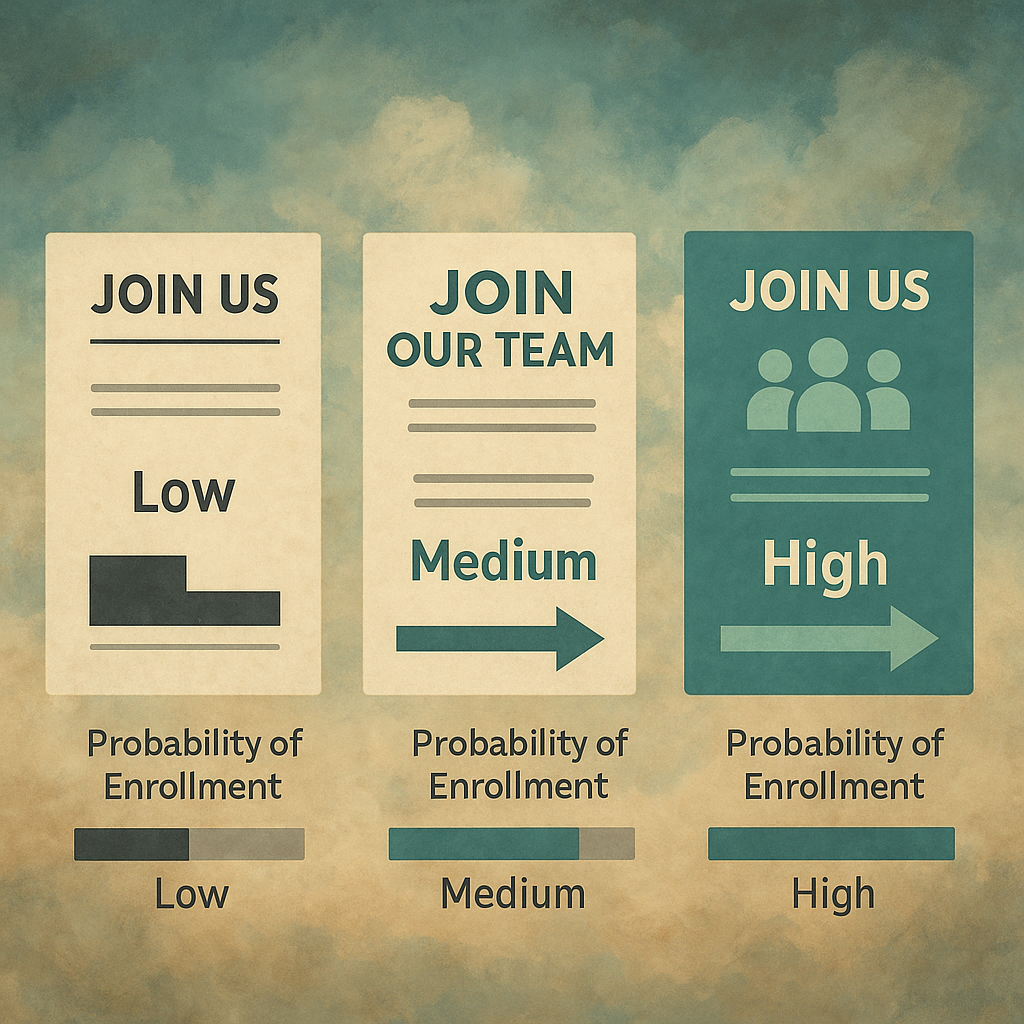
- Study Findings (2024): A study published in 2024 examined how different flyer designs affected people's willingness to authorize contact for future research studies.[60] Participants viewed either a standard neutral flyer, a flyer using simplified positive text, or a flyer using positive framing with prominent graphics.
- The results showed that positive framing significantly increased the stated likelihood of enrollment. The positive graphics flyer was particularly effective, boosting likelihood from 19.0% (neutral) to 28.7%.60 The positive text flyer also showed a numerical increase (to 24.2%), though not statistically significant on its own compared to the neutral baseline in all analyses.[60]
- Crucially, the positive framing did not negatively impact comprehension of what the authorization entailed. In fact, the increased willingness to enroll was most pronounced among participants who demonstrated the best understanding of the program.[60]
- Related HR Contexts: Framing also influences salary negotiations. An offer of $120,000 seems more appealing when framed as a $20,000 increase over a current $100,000 salary, compared to the same $120,000 offer framed as a $30,000 decrease from a requested $150,000 salary.[61] Similarly, framing a personnel selection process positively (e.g., focusing on selecting outstanding candidates) leads applicants to view the methods (like GPA or interviews) more favorably than framing it negatively (e.g., focusing on eliminating unqualified applicants).[62]
- Implications: In HR and recruitment, using clear, positive, and visually engaging communication can boost participation and favorable perceptions without misleading candidates or employees. It suggests that framing can be ethically used to make necessary processes (like research recruitment or understanding benefits) more accessible and motivating, particularly when clarity is maintained.[60]
Example 3: Medicine & Policy - High-Stakes Choices
- Context: Decisions in healthcare and the justice system often involve significant risks, complex probabilities, and life-altering consequences. Framing can powerfully sway these critical choices.
- Study 1 Findings (Arthroplasty, 2024): A recent study using hypothetical vignettes found that framing significantly influenced patients' decisions about total hip (THA) and total knee (TKA) arthroplasty.[63]
- For THA, framing complication risk positively ("98% of people will have no major complications") led 95% to say they would proceed, while the negative frame ("2% of people will have a major complication") reduced this to 88%.
- For TKA, framing long-term satisfaction positively ("80/100 of people will be happy") resulted in 97.1% willingness to proceed, compared to 89.7% for the negative frame ("20/100 people will be unhappy").
- In both cases, negative framing also significantly increased self-reported "worry" about the surgery.[63]
- Study 2 Findings (Plea Bargaining, 2023): Economist Alexander Lundberg's research, published in Economic Inquiry, modeled the impact of plea bargaining on wrongful convictions.[64]
- His model suggests that plea bargains, inherently framed as a way to avoid the potential loss (a harsher sentence) and uncertainty associated with a trial, can create pressure on defendants. This pressure is strong enough that even innocent individuals may be induced to plead guilty to secure a certain, lesser sentence rather than risk a potentially devastating outcome at trial.[64]
- The model found that relaxing restrictions on plea bargaining could lead to an increase in wrongful convictions.[64] Furthermore, factors like pre-trial detention can shift the defendant's reference point; imprisonment becomes the baseline, making a plea deal (leading to earlier release) feel like a gain rather than a loss of freedom, further increasing the likelihood of acceptance.[3]
- Implications: These examples underscore how seemingly subtle differences in presenting statistics (survival vs. mortality) or choices (guaranteed plea vs. risky trial) can have profound real-world consequences in domains where objectivity is paramount. It highlights the ethical responsibility of professionals in these fields to communicate information as clearly and neutrally as possible to support informed decision-making.[63]
Other Areas: The Framing Effect is ubiquitous. It influences product design, where choices about presenting discounts ("$200 off" vs "20% off"), scarcity messages ("Only 2 left!"), or calls-to-action ("Start Your Free Trial" vs "Sign Up") directly impact user behavior and conversion rates.[9] It's also central to political communication, where framing issues like taxation ("tax relief" vs "tax cuts") [1], public safety versus free speech (e.g., KKK rally) [25], or national decisions (e.g., Brexit) [67] shapes public opinion and voting patterns. The constant evolution of communication channels, particularly online platforms and social media, provides new arenas for framing effects to manifest and influence decisions.[10]
Why Do We Fall for It? The Psychology Behind the Frame
The Framing Effect isn't a sign of flawed intelligence; rather, it stems from the inherent way our brains process information, prioritize efficiency, and respond to emotional cues. Understanding the underlying psychological mechanisms helps explain why seemingly identical information can lead to vastly different choices.
Prospect Theory and the Power of Loss Aversion
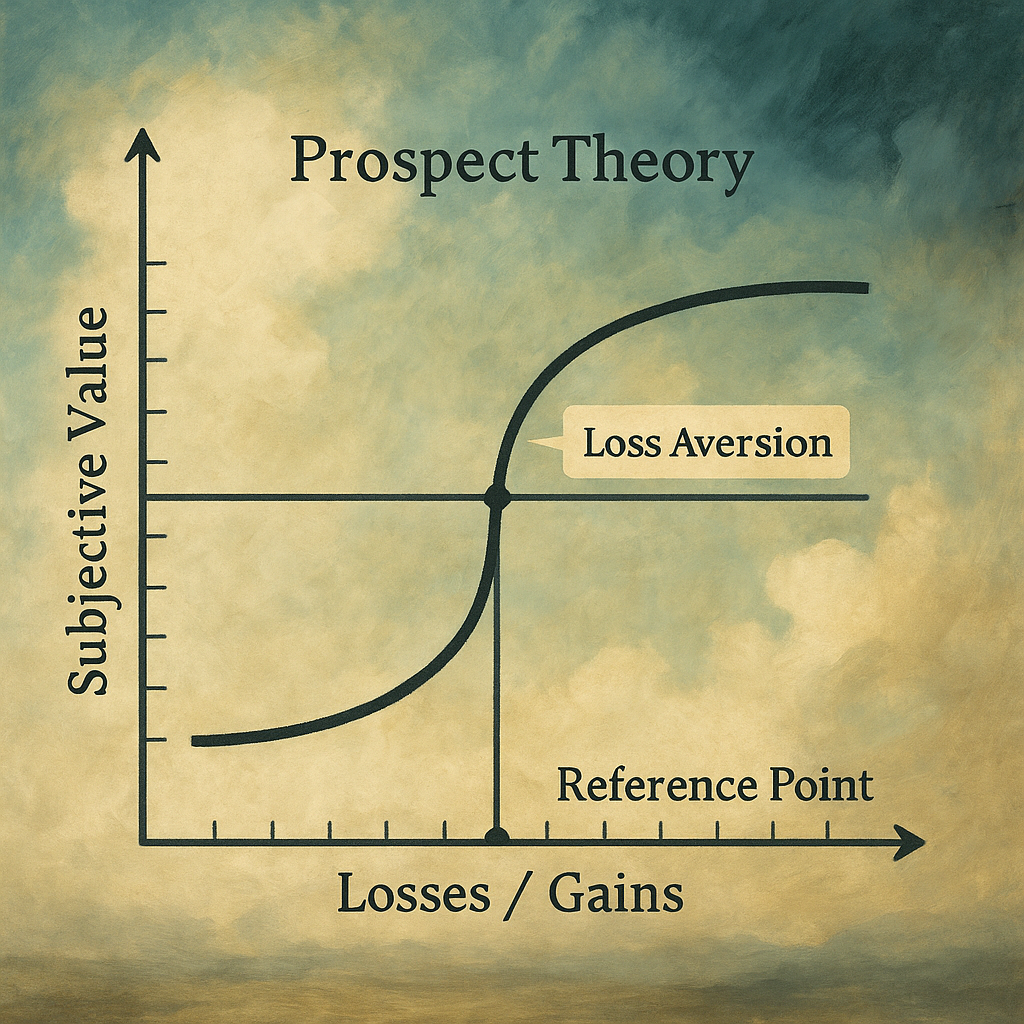
The cornerstone explanation for the Framing Effect, particularly gain/loss framing, comes from Kahneman and Tversky's Prospect Theory.[3] This theory proposes that we evaluate potential outcomes not based on their absolute final value, but relative to a reference point (often our current state). Central to this theory is Loss Aversion: the principle that losses loom larger than equivalent gains.[22] Psychologically, the pain of losing $100 feels roughly twice as intense as the pleasure of gaining $100.42
This aversion to loss directly fuels the Framing Effect.[1]
- When an option is framed as a gain, loss aversion isn't strongly triggered. We prefer the certainty of securing that gain, becoming risk-averse.
- When an option is framed as a loss, our powerful aversion to experiencing that loss kicks in. To avoid the guaranteed pain of a sure loss, we become more willing to take risks, hoping to negate the loss entirely.[4]
Mental Shortcuts: Heuristics at Play
Our brains constantly seek efficiency, relying on mental shortcuts, or heuristics, to make quick judgments. Framing often exploits these shortcuts:
- Affect Heuristic: We frequently make decisions based on our immediate emotional response—our "gut feeling"—rather than a drawn-out logical analysis.[1] Frames are powerful tools for manipulating these emotions. A "95% success rate" feels reassuring and positive, while a "5% failure rate" triggers anxiety and caution, even if they describe the same reality.[10] Neuroscientific studies suggest brain regions associated with emotion, like the amygdala, are activated differently depending on the frame, indicating an underlying emotional driver.[10]
- Availability Heuristic (Simplified): We tend to overestimate the importance of information that is easily recalled or readily understood.[1] Simple, vivid, or emotionally charged frames make certain aspects of a decision more mentally "available" than others. A frame focusing on "lives saved" makes the positive outcome salient, while one focusing on "lives lost" makes the negative outcome more prominent, influencing our focus and subsequent choice.
Dual-System Thinking: Fast vs. Slow Processing
Kahneman's model of dual-process thinking further illuminates the Framing Effect.[3] Our minds operate using two systems:
- System 1: Operates automatically, quickly, intuitively, and emotionally. It relies heavily on heuristics.
- System 2: Is slow, deliberate, analytical, and requires conscious effort.
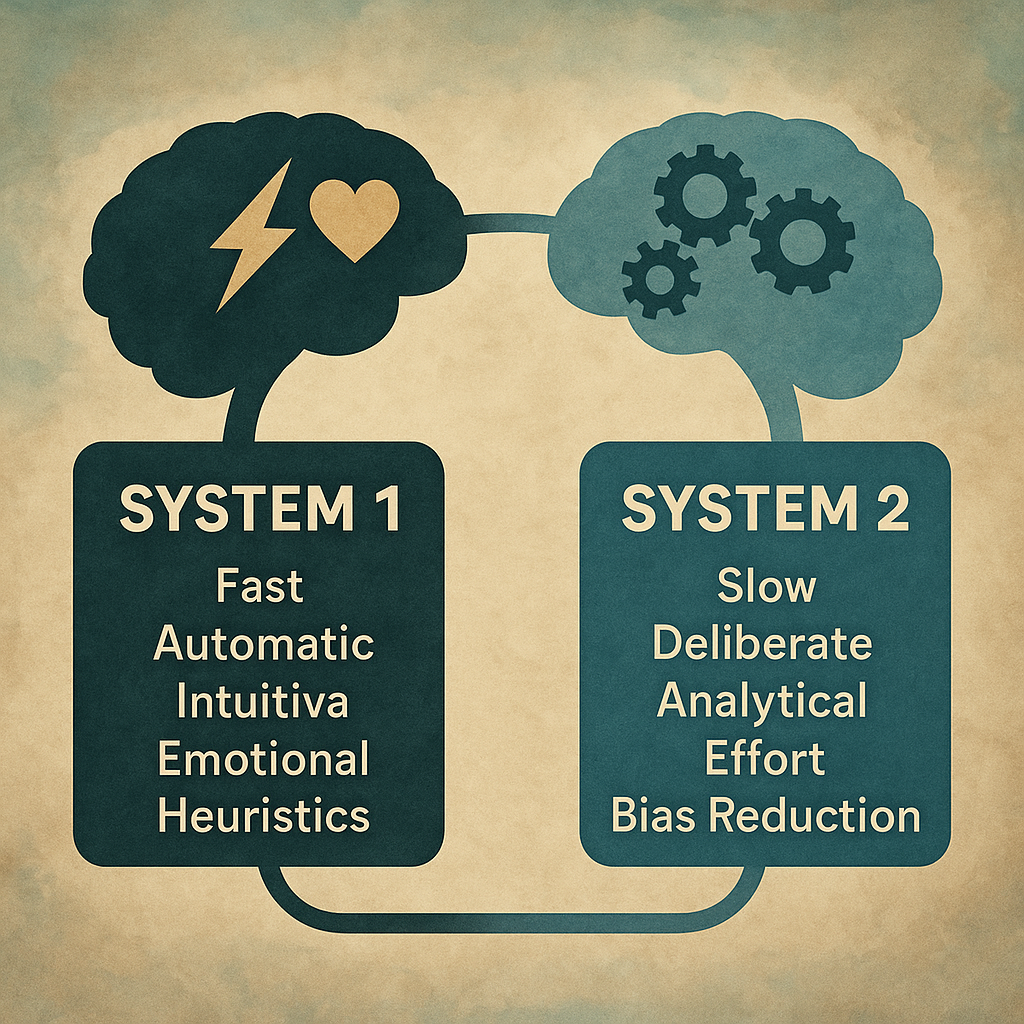
Framing typically targets System 1.[4] The way information is presented triggers an immediate, often emotional, intuitive response. We accept the frame passively because it requires less mental work.[7] Overcoming the bias necessitates engaging the more effortful System 2—consciously analyzing the underlying facts, questioning the presentation, and considering alternative perspectives.[7]
Cognitive Effort and Mental Miserliness
Our brains are inherently "cognitive misers," preferring to expend as little mental energy as possible.[2] Analyzing raw data, calculating probabilities, and comparing options requires significant cognitive effort. Framing simplifies this process by offering a pre-packaged interpretation. Accepting the frame is often easier than deconstructing it and evaluating the information objectively. This tendency towards efficiency, while generally adaptive, makes us vulnerable to manipulation through framing.[8]
Furthermore, susceptibility to framing isn't uniform. Factors like cognitive load (being mentally busy impairs System 2), age (older adults may have fewer cognitive resources and rely more on easily accessible information), and domain knowledge (experts are often less swayed by framing in their field) can influence how strongly the bias affects us.[3] Thinking in a foreign language can also reduce the effect, possibly due to increased cognitive distance and less automatic, emotional processing.[3]
In essence, the Framing Effect works by leveraging our innate aversion to loss, our reliance on emotional and availability heuristics, and our brain's preference for cognitive ease, often bypassing more effortful, analytical thinking.
Framing's Cousins: Related Biases in Our Thinking
The Framing Effect doesn't operate in a vacuum. It's part of a larger network of cognitive biases – systematic patterns of deviation from norm or rationality in judgment – that shape how we perceive the world and make choices. Understanding its relationship with closely related biases provides a richer picture of how our thinking can be influenced and offers broader strategies for clearer decision-making. The Cognitive Bias Codex, a visual map of many known biases, helps illustrate these connections.[89]
- Loss Aversion:
- Definition: As discussed previously, this is our powerful tendency to prefer avoiding losses over acquiring equivalent gains. The psychological impact of a loss is significantly greater than the impact of a gain of the same magnitude.[1] It's a fundamental aspect of Prospect Theory.[42]
- Connection to Framing: Loss Aversion is arguably the primary engine driving the most common type of framing (Gain vs. Loss). Framing works because of loss aversion. Presenting an option as a potential loss triggers this strong aversion, pushing us towards riskier choices to avoid that pain. Framing the same option as a potential gain feels less threatening and encourages safer, risk-averse behavior.[4] They are distinct concepts (Loss Aversion is the psychological tendency; Framing is the presentation technique), but inextricably linked in practice.[72]
- Anchoring Bias:
- Definition: This is our tendency to rely too heavily on the first piece of information we receive (the "anchor") when making subsequent judgments or decisions. We adjust away from the anchor, but often insufficiently.[9] This initial piece of information can even be arbitrary or irrelevant.[91]
- Connection to Framing: Framing often establishes the initial anchor or reference point.13 For example, presenting a high "original" price before revealing a discount frames the discount relative to that anchor, making the sale price seem more attractive.[6] Similarly, framing a negotiation offer as a "70% chance of success" anchors perception differently than "30% chance of failure".[6] The initial frame sets the context (the anchor) against which the details are evaluated.[90]
- Default Effect (Status Quo Bias):
- Definition: This bias describes our tendency to stick with a pre-selected option (the "default") rather than actively choosing an alternative.[40] This can be due to inertia, perceived endorsement (thinking the default is recommended), or the cognitive effort required to switch.[86] It's closely related to the Status Quo Bias, our general preference for the current state of affairs.[45]
- Connection to Framing: The effectiveness of a default option can be significantly influenced by how the choice itself is framed.[45] For example, framing the decision as "choosing" an option versus "rejecting" an option can interact with the default setting, sometimes making people more or less likely to stick with it.[98] Framing a default option positively (e.g., "Our Recommended Plan") makes it more appealing and harder to switch away from than a neutrally framed default.[77]
Other Related Biases (Briefly):
- Contrast Effect: How we perceive something depends on what we compare it to immediately beforehand. Framing often manipulates contrasts to make an option seem better or worse.[35]
- Decoy Effect: Introducing a third, strategically inferior option can increase the attractiveness of one of the original options. Framing choices often involves setting up such decoys.[31]
- Certainty/Pseudocertainty Effect: We tend to overweight outcomes that are considered certain relative to outcomes that are merely probable. Framing can create an illusion of certainty around one option.[3]
Recognizing that framing often works in concert with these other biases is important. It acts as the delivery mechanism – the way information is presented triggers loss aversion, sets an anchor, or reinforces a default. Therefore, strategies aimed at mitigating these related biases (like consciously challenging anchors or evaluating the status quo objectively) can also help counteract the influence of the frame itself, providing a more comprehensive toolkit for improving decision quality.
Breaking the Frame: Strategies for Clearer Decision-Making
While the Framing Effect is a powerful and pervasive influence on our thinking, we are not merely puppets controlled by the presentation of information. By cultivating awareness and employing specific cognitive strategies, we can learn to recognize frames, analyze information more objectively, and make decisions that align better with our goals and values. This is particularly vital for professionals whose roles involve making critical judgments and communicating effectively.[4] Overcoming this bias requires moving from passive acceptance to active evaluation.
Here are several practical techniques:
Cultivate Awareness ("See the Frame"): The essential first step is simply recognizing that framing exists and actively looking for it.[19] When encountering information or a decision point, consciously ask:
- How is this information being presented? Is it emphasizing gains or losses? Positive attributes or negative ones?
- What specific words or images are being used to create this frame?
- What might be being downplayed or omitted?.[7] Just pausing to identify the frame shifts thinking from automatic (System 1) to more deliberate (System 2).[8]
Reframe Actively ("Flip the Frame"): Don't just passively accept the presented frame; actively create alternative ones.[7]
- If information is presented positively (e.g., "90% success rate"), mentally restate it negatively ("10% failure rate").
- If presented as a loss (e.g., "You'll lose $100 if you don't act"), rephrase it as a gain (e.g., "You'll save $100 if you do act").
- Notice if your emotional response or preference shifts when you change the frame. This exercise forces a more balanced consideration of the core information.
Focus on Absolute Outcomes & Data ("Strip the Frame"): Train yourself to look past the descriptive language and focus on the objective, underlying facts and figures.[6]
- Ask: What are the actual numerical outcomes? What are the concrete consequences regardless of the spin?
- In the Asian Disease problem, this means recognizing that both "saving 200" and "400 dying" lead to the exact same end state out of 600 people.
- Where possible, rely on quantitative analysis (e.g., calculating expected values, comparing absolute numbers rather than percentages) to ground the decision in objective data.[21]
Seek Multiple Perspectives & Advice ("Change the Frame"): Break out of your own potential framing bias by involving others.[7]
- Discuss the decision with colleagues, mentors, or friends who might see it differently or offer a neutral viewpoint.[19]
- Consult credible experts or trusted sources; research shows that credible advice can significantly reduce or eliminate framing effects.[7]
- Consider the "outside view": How would someone not personally invested in the outcome frame this situation?.[7] Diverse inputs can reveal hidden assumptions or alternative framings.
Slow Down & Justify ("Analyze the Frame"): Resist the urge to make quick, intuitive decisions, especially for important matters.[7]
- Take time to deliberately analyze the options. Engage System 2 thinking.[82]
- Force yourself to articulate the reasons behind your potential choice. Techniques like listing the pros and cons (advantages and disadvantages) of each option before deciding have been shown experimentally to be effective debiasing strategies, as they encourage more thorough processing.[4]
Use Neutral Language ("Neutralize the Frame"): When you are the one presenting information or facilitating a decision (e.g., leading a meeting, conducting user research, writing a report), consciously strive for neutrality.[17[
- Avoid loaded words or emotionally charged phrasing that pushes towards a specific conclusion.
- Present both potential upsides and downsides fairly. Ask open-ended questions ("Tell me about your experience") rather than leading ones ("What did you dislike?").[17] This fosters a more objective environment for others to make decisions.
Increase Involvement & Knowledge ("Understand Beyond the Frame"): Deeper understanding of a subject makes you less susceptible to superficial framing.[4]
- Invest time in learning the substance of the issue. The more familiar you are with the underlying facts and complexities, the easier it is to see past the way they are presented.
- Higher involvement motivates more systematic processing of information, reducing reliance on the heuristic cues provided by the frame.[4]
These strategies require conscious effort, as simply being told about the bias often isn't enough to overcome it.96 They involve actively engaging analytical thinking, leveraging social resources, and focusing on the substance over the style.

Your Framing Effect Toolkit
Strategy | Description | Why it Works | Example Application |
1. Cultivate Awareness | Actively notice how information is presented (gain/loss, positive/negative emphasis). | Makes the unconscious influence conscious; engages System 2 thinking. | When reading a news headline, ask: "What perspective is being emphasized here?" |
2. Reframe Actively | Restate the information using the opposite frame (e.g., survival rate vs. mortality rate). | Forces consideration of the same facts from multiple angles; reveals if preference is frame-dependent. | If a sales pitch highlights "95% customer satisfaction," mentally rephrase it as "5% customer dissatisfaction" and see if it changes your feeling. |
3. Focus on Absolute Data | Ignore descriptive language; concentrate on objective numbers, facts, and end results. | Grounds the decision in reality rather than perception; bypasses emotional manipulation. | Comparing two investment options, calculate the absolute potential dollar returns/losses, not just percentage descriptions. |
4. Seek Perspectives | Discuss the decision with others; consult experts; consider an outsider's view. | Introduces alternative frames; leverages collective knowledge; credible advice can override initial frame. | Before making a major strategic decision, solicit input from team members with diverse roles and viewpoints. |
5. Slow Down & Justify | Avoid impulsive choices; take time to analyze; list pros and cons or provide rationales for each option. | Engages effortful System 2 processing; forces deeper evaluation beyond the surface frame. | When choosing between two software vendors, explicitly list the advantages and disadvantages of each before deciding. |
6. Use Neutral Language | When presenting information, use objective wording; avoid leading questions or emotionally charged terms. | Reduces the framing bias you impose on others; fosters more objective discussion and decision-making. | In a survey, ask "How satisfied were you with the service?" instead of "Were you happy with our amazing service?" |
7. Increase Involvement | Invest time in understanding the substance of the issue; become more knowledgeable about the domain. | Deeper knowledge reduces reliance on superficial cues; promotes systematic processing over heuristics. | If considering a new marketing strategy, research its underlying principles and data rather than just relying on the agency's framed pitch. |
By incorporating these techniques into decision-making processes, individuals and organizations can significantly reduce the distorting influence of the Framing Effect and move towards choices based more firmly on substance and logic.
Conclusion: What Frame Are You Choosing?
The Framing Effect is a testament to the intricate and often counterintuitive ways our minds navigate the world. It demonstrates that our reality is not simply perceived, but actively constructed, shaped by the context and language used to describe it.[8] As we've seen, the same set of facts, presented through different frames—gain versus loss, positive versus negative attributes, success versus failure rates—can lead to remarkably different judgments and decisions, influencing everything from our shopping habits and investment choices to critical medical procedures and public policy support.[3] This happens because framing taps into fundamental psychological mechanisms: our potent aversion to losses, our reliance on emotional shortcuts, and our brain's inherent drive for cognitive efficiency.[4]
Recognizing the power of framing is not about condemning our minds as inherently flawed or irrational. Rather, it's about understanding the architecture of our cognition. As Daniel Kahneman and Amos Tversky's work highlighted, these biases often arise from mental shortcuts that are usually adaptive and efficient.[82] The challenge lies in situations where these shortcuts lead us astray, particularly when frames are intentionally used to manipulate or obscure.
The crucial takeaway is that framing is, in many ways, unavoidable. As Kahneman suggests, information will inevitably be framed one way or another; the choice often lies in selecting the better frame—one that leads to more informed decisions or beneficial outcomes.[116] Similarly, Richard Thaler's concept of "choice architecture" emphasizes that the way choices are presented (the frame or nudge) inevitably influences behavior, underscoring the responsibility of those who design choices.[103] There is no perfectly neutral presentation, no "view from nowhere".[8]
However, awareness transforms us from passive recipients of framed information into active interpreters.[8] By understanding the mechanisms of framing and employing strategies like active reframing, focusing on objective data, seeking diverse perspectives, and slowing down our decision-making process, we gain agency.[9] We develop the ability to look through the frame, rather than just at it, evaluating the substance behind the presentation.
This understanding also carries an ethical dimension. For leaders, marketers, HR professionals, policymakers, and anyone involved in communicating information, recognizing the power of framing brings a responsibility to wield it thoughtfully.[11] While framing can be used ethically to simplify complex information, highlight important benefits (as seen in effective public health campaigns [121] or clear recruitment materials [60]), or "nudge" people towards better choices [103], it can also be used to mislead, manipulate, or exploit cognitive vulnerabilities.[11] The line between persuasion and manipulation can be thin, demanding conscious consideration of intent and impact.
Ultimately, the study of the Framing Effect reveals a fundamental tension between the ideal of pure rationality and the subjective, context-dependent nature of human perception. It reminds us that clarity is not just about the facts themselves, but also about how those facts are perceived. The world constantly presents us with frames, shaping our understanding and guiding our actions. Now that you can see the frame, the critical question remains: How will you choose to look through it, and how will you choose to frame the world for others?
Bibliography
- What Is the Framing Effect? | Definition & Examples - Scribbr, accessed: April 20, 2025, https://www.scribbr.com/research-bias/framing-effect/
- A Cognitive Psychology Blog » Keep it simple, silly. Design and the framing effect., accessed: April 20, 2025, https://web.colby.edu/cogblog/2018/04/26/user-experience-design-and-the-framing-effect/
- Framing effect (psychology) - Wikipedia, accessed: April 20, 2025, https://en.wikipedia.org/wiki/Framing_effect_(psychology)
- Framing effect - The Decision Lab, accessed: April 20, 2025, https://thedecisionlab.com/biases/framing-effect
- Framing Effect - The Uncertainty Project, accessed: April 20, 2025, https://www.theuncertaintyproject.org/bias/framing-effect
- Framing Effect: What It Is and Examples - Investopedia, accessed: April 20, 2025, https://www.investopedia.com/framing-effect-7371439
- Framing effect: how the way information is framed impacts our decisions - Ness Labs, accessed: April 20, 2025, https://nesslabs.com/framing-effect
- Framing: An Important and Often Unrecognized Mental Activity | Psychology Today, accessed: April 20, 2025, https://www.psychologytoday.com/us/blog/insight-therapy/201012/framing-an-important-and-often-unrecognized-mental-activity
- Framing Effect – Restructure - Learning Loop, accessed: April 20, 2025, https://learningloop.io/plays/psychology/framing-effect
- The Framing Effect in Marketing: Description, Psychology, and Examples, accessed: April 20, 2025, https://www.leadalchemists.com/marketing-psychology/framing-effect/
- The Power of the Framing Effect in Business Negotiations: How to Influence Decision-Making | Aligned, accessed: April 20, 2025, https://www.alignednegotiation.com/insights/framing-effect-in-business-negotiations
- Framing Effect In Psychology, accessed: April 20, 2025, https://www.simplypsychology.org/framing-effect.html
- Priming vs Framing vs Anchoring - The Customer Centroid, accessed: April 20, 2025, https://www.mxmoritz.com/article/priming-vs-framing-vs-anchoring
- Money Bias Series: Framing and Anchoring - Fyooz Financial Planning, accessed: April 20, 2025, https://www.fyoozfinancial.com/moneymatters-blog/moneybiasesframingandanchoring
- Framing, Anchoring and Confirming - Atwater Malick, accessed: April 20, 2025, https://www.atwatermalick.com/framing-anchoring-and-confirming
- What is the framing effect and how to manage it? - Mentimeter, accessed: April 20, 2025, https://www.mentimeter.com/blog/product-and-tech/what-is-the-framing-effect-and-how-to-manage-it
- Research Methodology: Mitigating the Framing Effect - Key Lime Interactive, accessed: April 20, 2025, https://info.keylimeinteractive.com/research-methodology-mitigating-framing-effect
- Be Aware of Your Decision Frame - Biased by Design, accessed: April 20, 2025, https://biasedbydesign.com/principles/be-aware-of-your-decision-frame/
- How Framing Bias Impacts Productivity - Routine.co, accessed: April 20, 2025, https://routine.co/blog/framing-bias
- Framing effect and financial decisions - Neuroprofiler, accessed: April 20, 2025, https://neuroprofiler.com/en/framing-effect-and-financial-decisions/
- Framing Bias: A Comprehensive Guide - Economics Online, accessed: April 20, 2025, https://www.economicsonline.co.uk/definitions/framing-bias-a-comprehensive-guide.html/
- FloodFlash behavioural science series: the framing effect, accessed: April 20, 2025, https://floodflash.co/floodflash-behavioural-science-series-the-framing-effect/
- The Framing Effect: Context is King | Shortform Books, accessed: April 20, 2025, https://www.shortform.com/blog/the-framing-effect/
- Framing Effect: Definition & Examples - Statistics By Jim, accessed: April 20, 2025, https://statisticsbyjim.com/basics/framing-effect/
- Framing effect (psychology) | EBSCO Research Starters, accessed: April 20, 2025, https://www.ebsco.com/research-starters/social-sciences-and-humanities/framing-effect-psychology
- The Framing Effect: How Perception Shapes Decision-Making - Verywell Mind, accessed: April 20, 2025, https://www.verywellmind.com/the-framing-effect-in-psychology-8713689
- Everything You Need To Know About The Framing Effect | REBOOT FOUNDATION, accessed: April 20, 2025, https://reboot-foundation.org/everything-you-need-to-know-about-the-framing-effect/
- Influence of framing on medical decision making - PMC, accessed: April 20, 2025, https://pmc.ncbi.nlm.nih.gov/articles/PMC4803019/
- Five Different Types of Framing Effects in Medical Situation: A Preliminary Exploration - PMC, accessed: April 20, 2025, https://pmc.ncbi.nlm.nih.gov/articles/PMC3652505/
- Framing effect: meaning & examples in marketing | Tasmanic®, accessed: April 20, 2025, https://www.tasmanic.eu/blog/framing-effect/
- Changing Decisions: The Interaction between Framing and Decoy Effects - PMC, accessed: April 20, 2025, https://pmc.ncbi.nlm.nih.gov/articles/PMC10525293/
- Using Credible Advice to Overcome Framing Effects, accessed: April 20, 2025, https://faculty.wcas.northwestern.edu/jnd260/pub/Druckman%20JLawEconOrg%202001.pdf
- Flow diagram of a simple process model of framing effects. - ResearchGate, accessed: April 20, 2025, https://www.researchgate.net/figure/Flow-diagram-of-a-simple-process-model-of-framing-effects_fig2_38178175
- Why Do We Fall For The Framing Effect? - YouTube, accessed: April 20, 2025, https://www.youtube.com/watch?v=Xb1LOEzw9qs&pp=0gcJCfcAhR29_xXO
- Definition, Example & How Framing Effect Works - Newristics, accessed: April 20, 2025, https://newristics.com/heuristics-biases/framing-effect
- Framing effect: influence of context and wording - Varify.io, accessed: April 20, 2025, https://varify.io/en/blog/framing-effect/
- The Neural Mechanism of the Social Framing Effect: Evidence from fMRI and tDCS Studies, accessed: April 20, 2025, https://pmc.ncbi.nlm.nih.gov/articles/PMC7189763/
- Framing effect in evaluation of others' predictions | Judgment and Decision Making, accessed: April 20, 2025, https://www.cambridge.org/core/journals/judgment-and-decision-making/article/framing-effect-in-evaluation-of-others-predictions/083F3CD39336100A906122383BFE667D
- A systematic review of risky-choice framing effects - PMC - PubMed Central, accessed: April 20, 2025, https://pmc.ncbi.nlm.nih.gov/articles/PMC10620856/
- Craig R. M. McKenzie Michael J. Liersch Shlomi Sher Framing Effects, Default Effects, and Trust, accessed: April 20, 2025, https://cognitionandculture.net/wp-content/uploads/Framing_defaults_trust.pdf
- Daniel Kahneman - Wikiquote, accessed: April 20, 2025, https://en.wikiquote.org/wiki/Daniel_Kahneman
- Prospect Theory - The Decision Lab, accessed: April 20, 2025, https://thedecisionlab.com/reference-guide/economics/prospect-theory
- Reference Point - The Decision Lab, accessed: April 20, 2025, https://thedecisionlab.com/reference-guide/economics/reference-point
- Lecture 6 (Loss Aversion and Framing Effects) Flashcards - Quizlet, accessed: April 20, 2025, https://quizlet.com/363362526/lecture-6-loss-aversion-and-framing-effects-flash-cards/
- (PDF) The joint effect of framing and defaults on choice behavior - ResearchGate, accessed: April 20, 2025, https://www.researchgate.net/publication/363279233_The_joint_effect_of_framing_and_defaults_on_choice_behavior
- The joint effect of framing and defaults on choice behavior - PMC, accessed: April 20, 2025, https://pmc.ncbi.nlm.nih.gov/articles/PMC10192178/
- The Effects of Priming on Framing Bias: An Integrative Study Examining Mortality Salience, Self-Affirmation, and Emotional Intelligence - ScholarWorks@CWU - Central Washington University, accessed: April 20, 2025, https://digitalcommons.cwu.edu/etd/1499/
- Loss Aversion, Framing, and Bargaining: The Implications of Prospect Theory for International Conflict Author(s): Jack S. Levy S - Department of Political Science, accessed: April 20, 2025, https://fas-polisci.rutgers.edu/levy/articles/1996%20Loss%20Aversion,%20Framing,%20&%20Bargaining.pdf
- You've Been Framed! | Psychology Today, accessed: April 20, 2025, https://www.psychologytoday.com/us/blog/consumed/201205/youve-been-framed
- How Do Framing Effects Impact Your Political Behavior? - Psychology Today, accessed: April 20, 2025, https://www.psychologytoday.com/us/blog/difference-opinion/202002/how-do-framing-effects-impact-your-political-behavior
- How Framing Effects Can Be Your Friend | Psychology Today, accessed: April 20, 2025, https://www.psychologytoday.com/us/blog/frame-it-again/202010/how-framing-effects-can-be-your-friend
- The devil's in the framing: language and bias | Philosophy, Logic and Scientific Method, accessed: April 20, 2025, https://www.lse.ac.uk/philosophy/blog/2022/02/08/the-devils-in-the-framing/
- Influence of the Framing Effect, Anchoring Effect, and Knowledge on Consumers' Attitude and Purchase Intention of Organic Food - Frontiers, accessed: April 20, 2025, https://www.frontiersin.org/journals/psychology/articles/10.3389/fpsyg.2020.02022/full
- Framing effects and anchoring | Intermediate Microeconomic Theory Class Notes - Fiveable, accessed: April 20, 2025, https://fiveable.me/intermediate-microeconomic-theory/unit-10/framing-effects-anchoring/study-guide/ko29vzFBM3nf8661
- Full article: Meaning and framing: the semantic implications of psychological framing effects - Taylor & Francis Online, accessed: April 20, 2025, https://www.tandfonline.com/doi/full/10.1080/0020174X.2020.1810115
- Framing: expanding the framing toolbox | The Marketing Society, accessed: April 20, 2025, https://www.marketingsociety.com/think-piece/framing-expanding-framing-toolbox
- Full article: Effects of Message Framing and Narrative Format on Promoting Persuasive Conversations with Others About the Flu Vaccine, accessed: April 20, 2025, https://www.tandfonline.com/doi/full/10.1080/10410236.2023.2257427
- Good News or Bad News? How Message Framing ... - Frontiers, accessed: April 20, 2025, https://www.frontiersin.org/journals/psychology/articles/10.3389/fpsyg.2020.568586/full
- Full article: The effects of message framing in CSR advertising on consumers' emotions, attitudes, and behavioral intentions - Taylor & Francis Online, accessed: April 20, 2025, https://www.tandfonline.com/doi/full/10.1080/19368623.2022.2065399
- Reframing Recruitment: Evaluating Framing in Authorization for ..., accessed: April 20, 2025, https://pmc.ncbi.nlm.nih.gov/articles/PMC10788686/
- Framing in Negotiation - PON, accessed: April 20, 2025, https://www.pon.harvard.edu/daily/business-negotiations/framing-in-negotiation/
- Effect of Framing on Applicants' Reactions to Personnel Selection Methods | Request PDF, accessed: April 20, 2025, https://www.researchgate.net/publication/228253952_Effect_of_Framing_on_Applicants'_Reactions_to_Personnel_Selection_Methods
- Positive and negative framing of complication risk and long-term outcomes influences decision-making in hip and knee arthroplasty - PubMed, accessed: April 20, 2025, https://pubmed.ncbi.nlm.nih.gov/39730258/
- Plea Bargains and Wrongful Convictions: Northwestern Professor's ..., accessed: April 20, 2025, https://www.feinberg.northwestern.edu/sites/health-policy/reevaluating-plea-bargains-unintended-consequences-on-wrongful-convictions.html
- Framing: Learn The Effect with Examples - Octet Design Studio, accessed: April 20, 2025, https://octet.design/journal/framing/
- Changing Decisions: The Interaction between Framing and Decoy Effects - MDPI, accessed: April 20, 2025, https://www.mdpi.com/2076-328X/13/9/755
- Framing and Political Decision Making: An Overview - Oxford Research Encyclopedias, accessed: April 20, 2025, https://oxfordre.com/politics/display/10.1093/acrefore/9780190228637.001.0001/acrefore-9780190228637-e-1250?d=%2F10.1093%2Facrefore%2F9780190228637.001.0001%2Facrefore-9780190228637-e-1250&p=emailAEdTDYscdSyZE
- 15+ Engaging Social Media Campaign Examples in 2025 - Superside, accessed: April 20, 2025, https://www.superside.com/blog/social-media-campaigns
- 2025 Marketing Trends to Watch Out For: Part 1 | Northbeam Blog, accessed: April 20, 2025, https://www.northbeam.io/post/2025-marketing-trends-to-watch-out-for-part-1
- The Best Marketing Campaigns of 2025 | Brand Vision, accessed: April 20, 2025, https://www.brandvm.com/post/best-marketing-campaigns-2025
- Loss aversion - BehavioralEconomics.com | The BE Hub, accessed: April 20, 2025, https://www.behavioraleconomics.com/resources/mini-encyclopedia-of-be/loss-aversion/
- Loss aversion - The Decision Lab, accessed: April 20, 2025, https://thedecisionlab.com/biases/loss-aversion
- thedecisionlab.com, accessed: April 20, 2025, https://thedecisionlab.com/biases/framing-effect#:~:text=Loss%20aversion%20encourages%20us%20to,bring%20either%20gain%20or%20loss.
- Framing – Gains, Losses, & Certainty vs Uncertainty - Behavior Matters!, accessed: April 20, 2025, https://blog.lanterngroup.com/framing-gains-losses-certainty-vs-uncertainty
- Trust versus loss aversion: Why does loss framing work? - VoxDev, accessed: April 20, 2025, https://voxdev.org/topic/health/trust-versus-loss-aversion-why-does-loss-framing-work
- Loss aversion, the endowment effect, and gain-loss framing shape preferences for noninstrumental information - PMC, accessed: April 20, 2025, https://pmc.ncbi.nlm.nih.gov/articles/PMC9407664/
- Default Effect – Restructure & Oblige - Learning Loop, accessed: April 20, 2025, https://learningloop.io/plays/psychology/default-effect
- PT: You can avoid unconscious manipulation by the framing effect by using a technique known as hedonic framing. : r/PsychologicalTricks - Reddit, accessed: April 20, 2025, https://www.reddit.com/r/PsychologicalTricks/comments/6rdw08/pt_you_can_avoid_unconscious_manipulation_by_the/
- How advertisement framing increased loan demand by 25% - The Decision Lab, accessed: April 20, 2025, https://thedecisionlab.com/intervention/how-advertisement-framing-increased-loan-demand-by-25
- Quote by Daniel Kahneman: “Framing effects: Different ways of presenting t...” - Goodreads, accessed: April 20, 2025, https://www.goodreads.com/quotes/10151323-framing-effects-different-ways-of-presenting-the-same-information-often
- Showing all quotes that contain 'tversky'. - Goodreads, accessed: April 20, 2025, https://www.goodreads.com/quotes/search?page=2&q=tversky
- Cognitive debiasing 1: origins of bias and theory of debiasing | BMJ Quality & Safety, accessed: April 20, 2025, https://qualitysafety.bmj.com/content/22/Suppl_2/ii58
- Quotes by Daniel Kahneman (Author of Thinking, Fast and Slow) - Goodreads, accessed: April 20, 2025, https://www.goodreads.com/author/quotes/72401.Daniel_Kahneman?page=54
- Nudge Theory: A Complete Overview - BusinessBalls, accessed: April 20, 2025, https://www.businessballs.com/improving-workplace-performance/nudge-theory/
- Further reflections on the elimination of framing bias in strategic decision making | Request PDF - ResearchGate, accessed: April 20, 2025, https://www.researchgate.net/publication/230243839_Further_reflections_on_the_elimination_of_framing_bias_in_strategic_decision_making
- Default effect - Wikipedia, accessed: April 20, 2025, https://en.wikipedia.org/wiki/Default_effect
- Debiasing the framing effect: The effect of warning and involvement - ResearchGate, accessed: April 20, 2025, https://www.researchgate.net/publication/220197039_Debiasing_the_framing_effect_The_effect_of_warning_and_involvement
- Debiasing the framing effect in younger and older adults' medical decision making - WVU Research Repository - West Virginia University, accessed: April 20, 2025, https://researchrepository.wvu.edu/etd/2372/
- File:Cognitive bias codex en.svg - Wikimedia Commons, accessed: April 20, 2025, https://commons.wikimedia.org/wiki/File:Cognitive_bias_codex_en.svg
- thedecisionlab.com, accessed: April 20, 2025, https://thedecisionlab.com/biases/anchoring-bias#:~:text=While%20the%20anchoring%20bias%20is,reference%20point%20for%20subsequent%20judgments.
- Anchoring Bias - The Decision Lab, accessed: April 20, 2025, https://thedecisionlab.com/biases/anchoring-bias
- Anchoring and Framing | Behavioral Science Principles for Employee Engagement - Amino, accessed: April 20, 2025, https://partners.amino.com/interactive/behavioral-science-principles-anchoring-framing
- Anchoring bias vs Framing effect #psychology #cognitivebias #research #psychologyfacts #bias - YouTube, accessed: April 20, 2025, https://www.youtube.com/watch?v=rq_QyjqsM-E
- Anchoring bias vs Framing effect #psychology #cognitivebias #research #psychologyfacts #bias - YouTube, accessed: April 20, 2025, https://www.youtube.com/watch?v=ZZjO28-gAf0
- Anchoring,framing, availability bias. Please help differentiating them. : r/Step2 - Reddit, accessed: April 20, 2025, https://www.reddit.com/r/Step2/comments/rl5yhs/anchoringframing_availability_bias_please_help/
- Is it time for studying real-life debiasing? Evaluation of the effectiveness of an analogical intervention technique - PubMed Central, accessed: April 20, 2025, https://pmc.ncbi.nlm.nih.gov/articles/PMC4523707/
- (PDF) Marketing Implications of Framing in the Decision‑Making - ResearchGate, accessed: April 20, 2025, https://www.researchgate.net/publication/328590648_Marketing_Implications_of_Framing_in_the_Decision-Making
- Framing the Default - PubMed, accessed: April 20, 2025, https://pubmed.ncbi.nlm.nih.gov/39385499/
- Influence of Choosing Versus Rejecting Frame on Default Effects - PMC, accessed: April 20, 2025, https://pmc.ncbi.nlm.nih.gov/articles/PMC11612645/
- Revisiting Default Effect and Framing Effect with a replication and extension of Johnson and Goldstein, accessed: April 20, 2025, https://open.lnu.se/index.php/metapsychology/article/view/3108/3438
- (PDF) Framing the Default: Influence of Choosing vs Rejecting Frame on Default Effects - ResearchGate, accessed: April 20, 2025, https://www.researchgate.net/publication/375547834_Framing_the_Default_Influence_of_Choosing_vs_Rejecting_Frame_on_Default_Effects
- Reducing Default and Framing Effects in Privacy Decision-Making - AIS eLibrary, accessed: April 20, 2025, https://aisel.aisnet.org/cgi/viewcontent.cgi?article=1002&context=sighci2018
- Nudge Quotes by Richard H. Thaler - Goodreads, accessed: April 20, 2025, https://www.goodreads.com/work/quotes/2535409-nudge-improving-decisions-about-health-wealth-and-happiness
- Framing effect studies | PPT - SlideShare, accessed: April 20, 2025, https://www.slideshare.net/slideshow/framing-effect-studies/62031826
- Framing Effect: Shaping Customer Experience Through Strategic Presentation, accessed: April 20, 2025, https://www.renascence.io/journal/framing-effect-shaping-customer-experience-through-strategic-presentation
- Want to Avoid Bad Decisions? It's All About Framing | Psychology Today, accessed: April 20, 2025, https://www.psychologytoday.com/us/blog/intentional-insights/201703/want-to-avoid-bad-decisions-its-all-about-framing
- What is the framing effect? - Those Nerdy Girls, accessed: April 20, 2025, https://thosenerdygirls.org/framing-effect/
- Framing effect – Learn everything you need about framing bias - Develop Diverse, accessed: April 20, 2025, https://developdiverse.com/deib_dictionary/framing-effect/
- Framing Bias - Corporate Finance Institute, accessed: April 20, 2025, https://corporatefinanceinstitute.com/resources/career-map/sell-side/capital-markets/framing-bias/
- Framing effect debiasing in medical decision making - Iowa State University Digital Repository, accessed: April 20, 2025, https://dr.lib.iastate.edu/bitstreams/d2cc2bb0-0e23-4083-a2ee-19bceadd2269/download
- Framing effect debiasing in medical decision making - ResearchGate, accessed: April 20, 2025, https://www.researchgate.net/publication/5685736_Framing_effect_debiasing_in_medical_decision_making
- Framing effect debiasing in medical decision making - PubMed, accessed: April 20, 2025, https://pubmed.ncbi.nlm.nih.gov/18164168/
- How to prevent framing bias - Uxcel, accessed: April 20, 2025, https://app.uxcel.com/lessons/cognitive-biases-988/how-to-prevent-framing-bias-9109
- (PDF) Framing and Bias: A Literature Review of Recent Findings - ResearchGate, accessed: April 20, 2025, https://www.researchgate.net/publication/325856391_Framing_and_Bias_A_Literature_Review_of_Recent_Findings
- Framing and the health policy process: a scoping review - PMC - PubMed Central, accessed: April 20, 2025, https://pmc.ncbi.nlm.nih.gov/articles/PMC4916318/
- jarango.com, accessed: April 20, 2025, https://jarango.com/2019/03/27/daniel-kahneman-on-framing-and-incentives/#:~:text=Mr.,one%20way%20or%20the%20other.
- Daniel Kahneman on Framing and Incentives - Jorge Arango, accessed: April 20, 2025, https://jarango.com/2019/03/27/daniel-kahneman-on-framing-and-incentives/
- Nudge - Admired Leadership, accessed: April 20, 2025, https://admiredleadership.com/book-summaries/nudge/
- Nudge by Cass Sunstein and Richard Thaler – Book Summary, Notes and Quotes, accessed: April 20, 2025, https://parentotheca.com/2024/02/29/nudge-cass-sunstein-and-richard-thaler-book-summary/
- More than nudges are needed to save the world from climate change - Sydney Business Insights, accessed: April 20, 2025, https://sbi.sydney.edu.au/more-than-nudges-are-needed-to-save-the-world-from-climate-change/
- Framing Success Stories, accessed: April 20, 2025, https://www.unmc.edu/publichealth/_documents/services/ophp/vipsuccessstories.pdf
- More than a message: Framing public health advocacy to change corporate practices, accessed: April 20, 2025, https://www.bmsg.org/resources/publications/more-than-a-message-framing-public-health-advocacy-to-change-corporate-practices/
- More Than a Message: Framing Public Health Advocacy to Change Corporate Practices, accessed: April 20, 2025, https://www.bmsg.org/wp-content/uploads/2005/06/bmsg_report_more_than_a_message_framing_public_health_advocacy_to_change_corporate_practices.pdf
