
The Oddball Advantage
How the Von Restorff Effect Shapes Memory and Decisions (And How You Can Use It)
Summary
The Von Restorff effect describes our natural inclination to remember things that stand out or are unusual more easily than uniform items. Apple's successful "Think Different" campaign in 1997, which associated their brand with iconic nonconformists, serves as a compelling example of this principle in action, revitalizing their image by positioning them as different in the computer industry.
This psychological phenomenon reveals that our brains are wired to pay closer attention to and retain information that breaks from the norm, impacting not only how we perceive advertising but also more broadly influencing our memory and the decisions we make.
1. Introduction: Why Does the Oddball Stick in Our Minds?
In 1997, Apple Computer was struggling. Facing intense competition and declining market share, the company needed a radical shift. Enter the "Think Different" campaign. Instead of showcasing product features, the campaign celebrated "the crazy ones, the misfits, the rebels"—individuals like Albert Einstein, Mahatma Gandhi, and Amelia Earhart who stood out from the crowd and changed the world.[1] The campaign featured striking black-and-white portraits, making the message itself distinctive against the backdrop of typical tech advertising.[3] By aligning itself with these iconic "oddballs," Apple made itself the oddball in the computer industry, emphasizing creativity and non-conformity over corporate sameness. The campaign was a turning point, revitalizing Apple's brand image and setting the stage for its resurgence.[1] While the direct impact on immediate sales figures is debated, its role in reshaping perception and building long-term brand loyalty is widely acknowledged.[4]
Contrast this with the fate of products like Microsoft's Zune music player. Launched into a market dominated by the already iconic iPod, the Zune failed to offer significant differentiation and ultimately faded, unable to capture consumer memory or market share.8 Similarly, Crystal Pepsi, a clear cola launched in the 90s, created initial curiosity but ultimately failed because its distinction (being clear) lacked a clear purpose or connection to consumer expectations for a cola.[10] These examples, both successes and failures, point to a fundamental aspect of human cognition: distinctiveness matters.
This phenomenon isn't limited to multi-million dollar advertising campaigns or product launches. Consider a more mundane experience: trying to recall the names of people met at a recent networking event. Often, the name that springs to mind most easily belongs to the person who stood out—perhaps the one with the brightly colored jacket amidst a sea of grey suits, or the one who shared a particularly unusual anecdote. Similarly, scan a grocery list, and the item highlighted in fluorescent green is the one likely remembered later, even if it wasn't the most important.[12]
Why do these unique elements—the celebrated misfit, the failed clear cola, the person in the bright jacket, the highlighted grocery item—lodge themselves so firmly in our memory while the mundane fades away?.[16] This tendency isn't a random quirk; it's a well-documented psychological principle known as the Von Restorff effect, or the isolation effect.[12] It reveals that our brains are wired to notice and remember things that break the pattern. This effect has profound implications not just for memory, but for attention, decision-making, and communication in various professional contexts, from marketing and design to recruitment and even medicine.[18] However, as we will explore, the power of distinctiveness is a double-edged sword. While it can enhance recall, it can also lead our focus astray, as seen in phenomena like the "weapon focus effect" in eyewitness testimony, where memory for a salient weapon can impair recall of other crucial details.[22] Understanding this bias—what it is, why it happens, where we see it, how to use it wisely, and how to avoid its pitfalls—is crucial for anyone looking to communicate effectively or make sound judgments in a world saturated with information.
2. Meet the Von Restorff Effect: Making Memories Memorable
At its core, the Von Restorff effect is elegantly simple: when presented with a collection of similar items (homogeneous stimuli), the one item that differs from the rest (the isolate) is more likely to be remembered.[12] This principle is also commonly referred to as the "isolation effect," and sometimes the "bizarreness effect" or the "distinctiveness principle," all pointing to the same core idea: difference drives memory.[3]
The effect is named after the German psychiatrist and pediatrician Hedwig von Restorff (1906–1962).[12] In her 1933 study, von Restorff explored memory phenomena using what is now known as the "isolation paradigm".[53] While she wasn't the first to use this approach, her systematic experiments solidified the concept.[19] She presented participants with lists containing mostly similar items (like nonsense syllables or numbers) but included one item of a different type (e.g., a number within a list of syllables, or vice versa).[17] Her consistent finding was that participants demonstrated significantly better recall for these isolated, distinct items compared to the homogeneous items surrounding them.[12] Interestingly, von Restorff's original research was aimed at understanding interference effects in memory—how similar items might "agglutinate" or blend together, making them harder to recall individually, while the distinct item escapes this interference.[53] Sadly, her promising academic career was cut short by the Nazi regime's purge of universities in the 1930s.[39]
The power of this effect lies in its universality, easily illustrated through everyday analogies. Imagine a bowl brimming with crisp green apples; if a single bright red apple sits among them, it immediately captures attention and is far more memorable later.[14] Think of scanning a page of text and encountering a word printed in bold, italics, or a different color—that word leaps out and sticks.[3] Consider a list of furniture words: desk, chair, bed, table, chipmunk, dresser, stool, couch. The word "chipmunk" is the most likely to be recalled because its meaning (an animal) is conceptually distinct from the others.[12] Other simple examples include the one red circle among many black ones [57], the one number in a string of letters [17], the one upside-down image [37], or the single highlighted item on a shopping list.[12] These common experiences underscore that the Von Restorff effect isn't just a laboratory curiosity but a fundamental aspect of how our memory prioritizes information.
Distinctiveness itself can manifest in numerous ways. It can be physical or perceptual, involving differences in size, shape, color, font, spacing, underlining, highlighting, motion, or orientation.[12] It can also be conceptual or semantic, arising from differences in meaning, category, unexpectedness, bizarreness, humor, or emotional significance.[3] The key requirement is that the item breaks the pattern established by its surrounding context. This inherent flexibility in how distinctiveness can be achieved makes the Von Restorff effect a widely applicable principle.
A crucial nuance, highlighted by von Restorff herself and supported by later research, is that obvious perceptual salience—the quality of immediately standing out visually—is not strictly necessary for the effect to occur.[12] She demonstrated the effect even when the isolated item appeared early in the list (e.g., the second or third item), before the participant could know it was unusual relative to the items that followed.[52] This suggests that the effect isn't just about initial surprise, but also about how the item is processed in relation to the overall context, particularly the similarity of the background items.[28] The more uniform the background, the more potent the isolation.
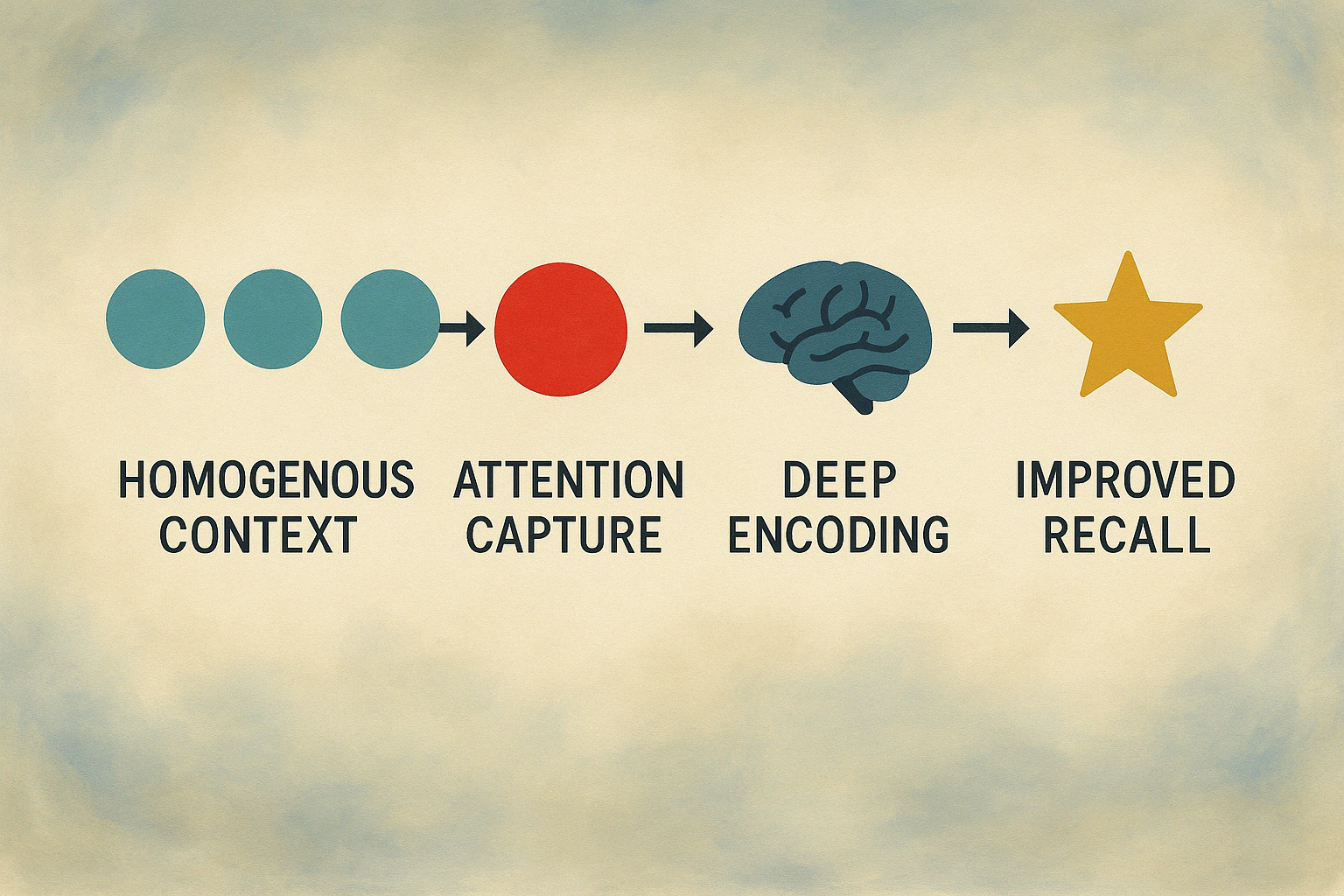
3. The Brain's Spotlight: How the Isolation Effect Works
Why does our brain prioritize the oddball? The explanation lies in the interplay of attention, encoding, novelty detection, and the importance of context. Our cognitive system is constantly bombarded with information, far more than it can fully process. Attention acts as a crucial gatekeeper, filtering this influx and directing resources towards what seems most important.[16] Distinctive items, by their very nature of breaking a pattern, act like signals that automatically capture this limited attentional spotlight.[12] As researchers Shelley Taylor and Susan Fiske noted, "attention is usually captured by salient, novel, surprising, or distinctive stimuli".[20]
This captured attention isn't just fleeting; it triggers deeper or more elaborate encoding processes for the distinctive item.[3] Several theories attempt to explain this encoding advantage. The "total-time hypothesis" suggests that isolated items are simply rehearsed more or held in working memory longer than their homogeneous neighbors.[12] Another idea posits that the brain treats the isolate as belonging to its own unique category, making it easier to organize and later retrieve.[12] A further explanation focuses on the deeper cognitive analysis involved in processing the similarities among the background items and the differences presented by the isolate.[12] Regardless of the precise mechanism, the result is a stronger, more durable memory trace for the item that stood out.
Modern cognitive science often emphasizes the role of contextual incongruity or novelty in driving this differential attention.[12] An item becomes memorable primarily because it violates the expectation set by the surrounding context.[65] This sensitivity to the unusual likely has deep evolutionary roots. For our ancestors, noticing something out of the ordinary—a flash of color in the green jungle, an unfamiliar sound in the quiet night—could signal a potential threat (a predator) or a valuable opportunity (a new food source), making rapid detection and memory crucial for survival.[3] Our brains remain wired to prioritize such deviations from the norm.
Neuroscientific studies using Event-Related Potentials (ERPs) provide glimpses into the brain's activity during this process. Exposure to novel or isolated items consistently elicits distinct ERP components, such as the N2b, P3a, and P3b, which are associated with novelty detection and attentional allocation.[12] This confirms that the brain does indeed register and process distinctive stimuli differently at a neural level. However, the relationship isn't perfectly straightforward. Research indicates that the magnitude of these initial novelty-related ERP signals (like the N2-P3 complex) doesn't always strongly predict how much better the isolated item will be recalled compared to forgotten ones.[63] This suggests that while novelty detection is important for capturing attention, subsequent, perhaps more elaborate, encoding processes are also critical for cementing the memory advantage of the distinctive item. It's not just about the initial "aha, that's different!" moment, but what the brain does with that information afterward.
This brings us back to the debate around perceptual salience. As von Restorff argued, an item doesn't need to be immediately, strikingly different visually to be better remembered.[54] Semantic isolates (like "chipmunk" among furniture) or items placed early in a list still show the effect.[12] This reinforces that the effect is driven by the item's distinctiveness relative to the established context—the pattern formed by the homogeneous background items. The more consistent and similar the background, the more any deviation stands out, whether that deviation is immediately obvious or becomes apparent through deeper semantic processing. Context, therefore, is king; the power of the isolate lies in its contrast with the ordinary.
4. Standing Out in the Real World: Examples Across Industries
The Von Restorff effect isn't confined to psychology labs or theoretical discussions. Its principles are actively, often strategically, applied across a wide range of professional fields, influencing everything from consumer choices to patient care to hiring decisions. Examining recent examples highlights the effect's versatility and ongoing relevance.
Example 1: Marketing/Branding - Liquid Death (Recent: 2019-Present)
- Field: Marketing & Branding
- Case: Liquid Death, a canned water brand launched in 2019, aggressively defies category norms. While most water brands emphasize purity, health, and serene imagery, Liquid Death adopts a heavy metal aesthetic. Its tallboy aluminum cans feature skull logos, gothic fonts, and taglines like "Murder Your Thirst" and "#DeathToPlastic".[19] Their marketing stunts are equally unconventional, including releasing albums based on hate comments or collaborating with Tony Hawk on a skateboard infused with his blood.[85]
- Von Restorff Application: This strategy employs extreme conceptual and visual distinctiveness. By being the polar opposite of typical water branding, Liquid Death becomes highly salient and memorable, leveraging the "bizarreness" aspect of the effect.[19] The aluminum can itself is a physical differentiator against the sea of plastic bottles, linked to their sustainability message.[84]
- Impact: The brand has achieved rapid growth, reporting over $250 million in retail sales in 2023.[87] Its distinctive approach generates significant social media buzz, high brand recall, and a loyal "cult-like" following that extends beyond the typical heavy metal demographic.[83] This demonstrates how radical distinctiveness can carve out a significant niche in a saturated market.

Example 2: UX/UI Design - Subscription Tier Highlighting (Ongoing/Recent)
- Field: User Experience (UX) / User Interface (UI) Design
- Case: It's common practice on websites offering tiered subscriptions or pricing plans (e.g., SaaS products, news publishers) to visually highlight one specific option—often labeled "Most Popular" or "Recommended".[57] This highlighting is achieved through design elements like a contrasting border color, a different background shade, a prominent badge, or making the entire box slightly larger than the others.[18] Examples cited include Kissflow [57], Sydney Morning Herald [90], Dropbox [91], Hubspot [18], and Tira Beauty.[18]
- Von Restorff Application: This uses physical distinctiveness (color, size, shape, labels) to make the target option stand out against the relatively homogeneous presentation of the other tiers.[20] The visual contrast draws the user's attention, making that option more likely to be noticed, considered, and potentially remembered.[18]
- Impact: This design pattern effectively guides user attention towards the business's preferred option, potentially increasing selection rates for that tier.[90] It also reduces the cognitive load for the user by simplifying the choice and offering a clear recommendation.[18] However, it's worth noting that while attention is captured, selection isn't guaranteed, as user preference still plays a significant role.[93]

Example 3: Business Strategy/Communication - Unique Value Proposition Emphasis (Ongoing)
- Field: Business Strategy & Communication
- Case: Companies often build their strategic positioning around emphasizing one key differentiator that sets them apart from competitors. Apple, for instance, consistently focused on design elegance and intuitive user experience as its unique selling points, especially when competitors were emphasizing technical specifications or price.[3] Another example could be a service firm highlighting a unique money-back guarantee or a proprietary process that delivers results differently.
- Von Restorff Application: This leverages conceptual distinctiveness. By isolating and repeatedly communicating one core differentiator against the backdrop of standard industry features or practices, that unique aspect becomes strongly associated with the brand and highly memorable.[3] It helps define the brand's identity in the consumer's mind.
- Impact: This strategy aids in building strong brand recall and differentiation, crucial for achieving "mental availability"—being easily thought of in a buying situation.[19] It can significantly influence consumer perception and preference, even if the highlighted feature isn't the only factor determining quality or value.[3] In a world of information overload, focusing communication on a single, memorable point of difference helps cut through the noise.[16]
Example 4: Recruitment/HR - The Standout CV/Candidate (Anecdotal/Illustrative)
- Field: Recruitment & Human Resources
- Case: Imagine a recruiter sifting through hundreds of similar-looking CVs. One candidate has included a small, visually distinct graphic representing a key project's success, or perhaps used a unique but professional template.[96] Alternatively, during interviews where candidates often give practiced answers, one candidate offers a genuinely novel insight or uses a particularly memorable, relevant analogy to explain their experience. Even the design of job application platforms often uses the effect, making the "Apply" button visually distinct.[18]
- Von Restorff Application: The unique element—whether visual (CV format) or conceptual (interview answer, unique experience)—makes that candidate "pop" from the homogeneous pool of applicants.[96] This distinctiveness increases the probability that the recruiter or hiring manager will remember that specific candidate during the review and decision-making process.
- Impact: A candidate who is positively remembered is more likely to be shortlisted, recalled favorably during deliberations, and potentially receive an interview invitation or job offer. The key, however, is that the distinctiveness must be perceived as relevant and positive, not merely odd or unprofessional. One anecdote involved a candidate named Will Smith whose uniquely formatted CV, while criticized by some recruiters, secured him multiple interviews from business owners who appreciated the standout approach.[96]
Example 5: Medicine/Patient Recall - Emotional Word in Memory Test (RAVLT Study - 2019)
- Field: Medicine / Clinical Psychology / Assessment
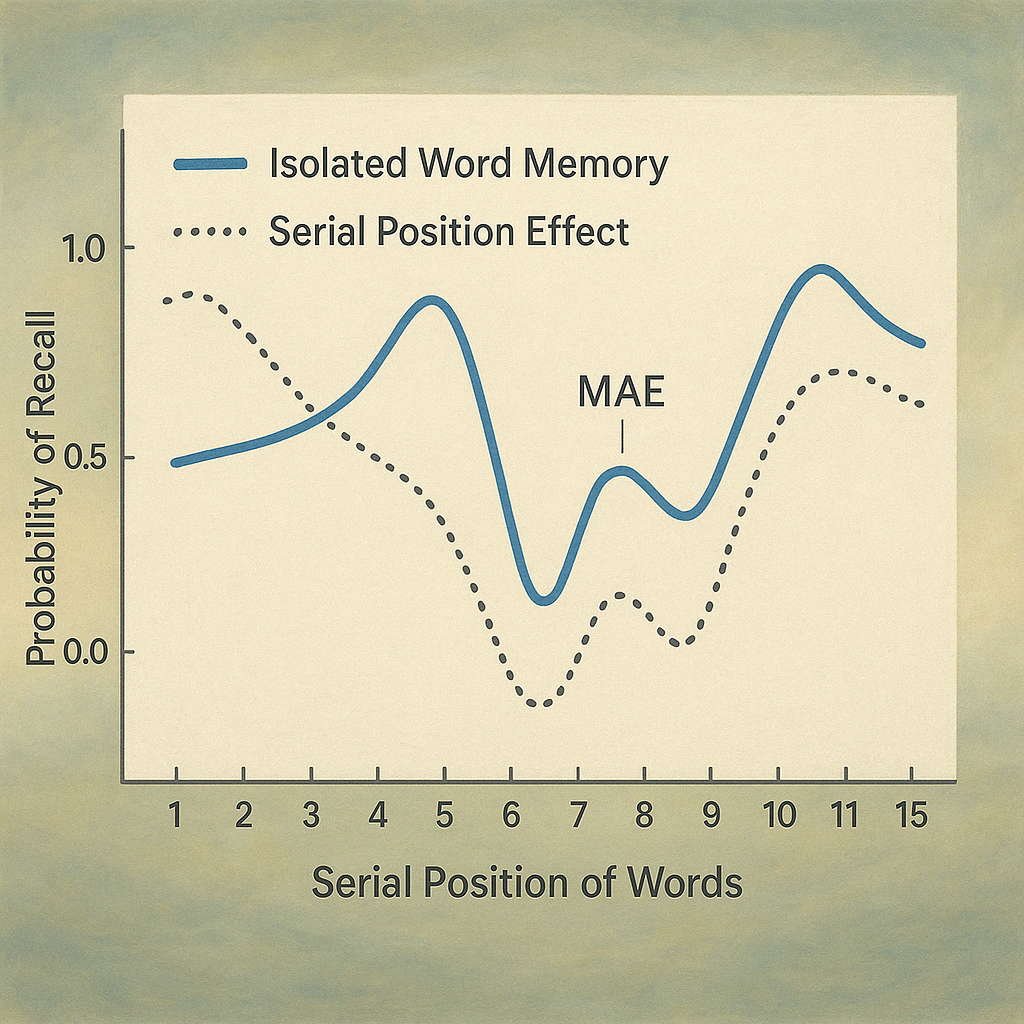
- Case: A 2019 study utilized a revised Brazilian Portuguese version of the Rey Auditory Verbal Learning Test (RAVLT), a standard neuropsychological test for memory. This version strategically placed the word ‘MÃE’ (mother) in the middle of a list of otherwise emotionally neutral words presented to participants.[60]
- Von Restorff Application: The word 'MÃE' served as a semantic and potentially emotional isolate. Its distinct emotional weight compared to the neutral context words was hypothesized to make it more memorable.[60]
- Impact: The study confirmed the hypothesis. Participants, including healthy elderly individuals and patients with Mild Cognitive Impairment (MCI) and early-stage Alzheimer's Disease (AD), recalled the word 'MÃE' significantly better than the surrounding neutral words.60 This demonstrated the robustness of the Von Restorff effect even in populations with memory challenges. This finding has implications for clinical assessment design and potentially for patient communication, suggesting that making crucial instructions or information emotionally or conceptually distinct could enhance patient recall.
These examples, spanning diverse fields, illustrate the broad applicability of the Von Restorff effect. Whether consciously applied or observed naturally, the principle that distinctiveness drives memory holds true. Successful applications tend to be strategic, aiming to guide attention, reinforce a specific message, or enhance recall in a meaningful way, demonstrating the practical power of understanding this cognitive bias. The recency of examples like Liquid Death and current UX practices further underscores the principle's continued relevance in today's professional landscape.
5. When Different Isn't Better: Common Mistakes and Pitfalls
While the Von Restorff effect offers a powerful way to capture attention and enhance memory, wielding distinctiveness requires care. Making something stand out isn't inherently beneficial; misapplication can lead to confusion, negative perceptions, or even hinder communication. Understanding the common pitfalls is crucial for using this effect effectively and ethically.
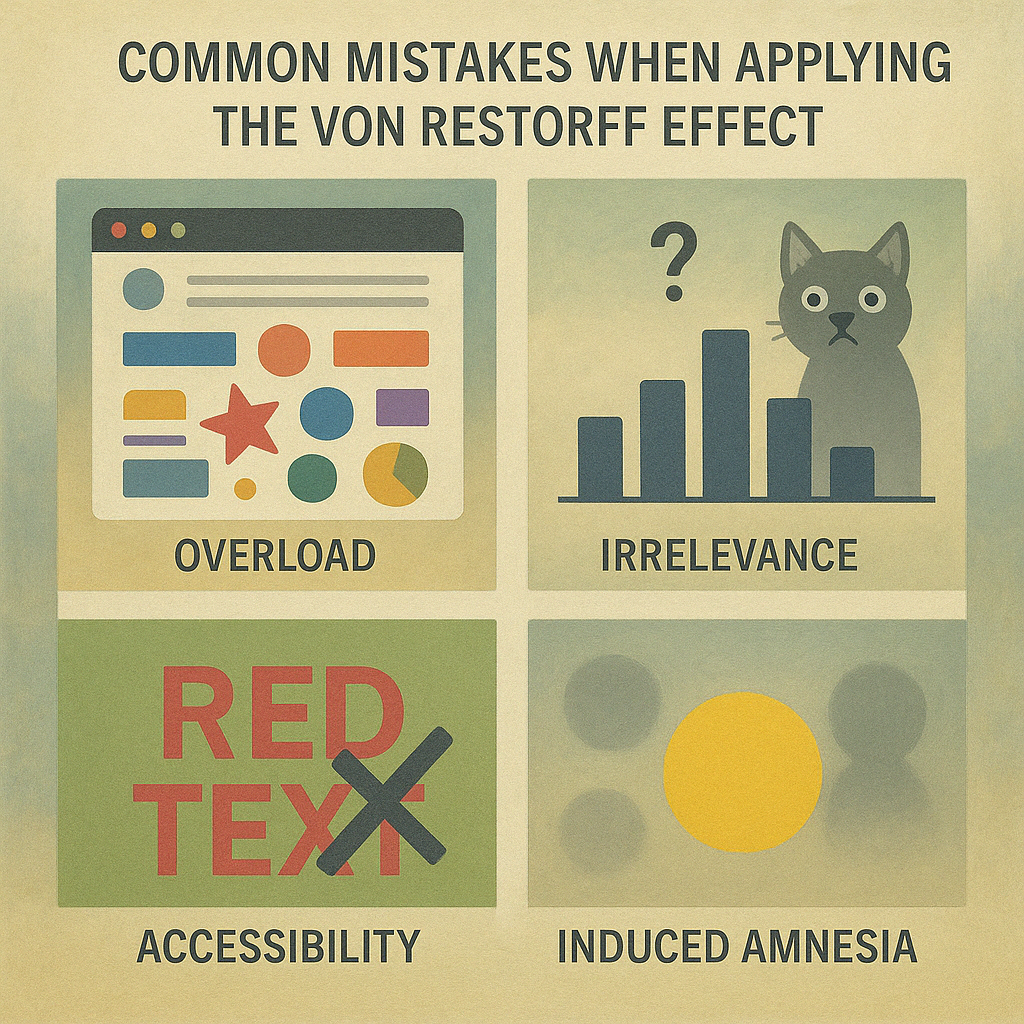
The Overuse Trap (Dilution): The core principle of the effect relies on contrast with a homogeneous background. If too many elements are highlighted or made distinct, nothing truly stands out anymore. The contrast is lost, and the effect is diluted or negated entirely.[14] Imagine a webpage where every other word is bolded, or a presentation slide where five different points are circled in bright red – the intended emphasis is lost in the visual noise. Therefore, contrast must be used sparingly and purposefully, reserved only for the truly critical information or actions.[16]
Irrelevance and Gimmicks: Distinctiveness needs a purpose. Making something stand out just for the sake of being different, without relevance to the message or value proposition, might grab fleeting attention but won't necessarily lead to positive recall or desired action.[16] A random, unrelated meme in a serious training module might be momentarily amusing but distracts from the learning objective.[16] The distinct element should ideally reinforce the key message or highlight a genuine benefit. There needs to be a clear rationale for why a particular item is being singled out.[20]
Accessibility Failures: A common mistake is relying solely on methods of distinction that create barriers for some users. Using color contrast alone to highlight important information can exclude individuals with color vision deficiencies.[20] Similarly, using flashing animations or excessive motion to make an element stand out can be problematic or even harmful for users with motion sensitivities or vestibular disorders.[102] Ethical and effective design requires ensuring that distinctiveness is achieved through multiple cues (e.g., combining color with icons, text labels, or sufficient non-color visual hierarchy) and that accessibility standards are met.
Negative Associations and Banner Blindness: Sometimes, making an element too distinct in a way that mimics intrusive advertising can backfire. Users have developed "banner blindness," a tendency to automatically ignore page elements that look like ads, even if they aren't.[91] If a highlighted call-to-action or information box adopts the visual style of a typical banner ad (e.g., isolated in a right-hand column, using overly aggressive colors or animation), users might filter it out unconsciously.[91] Furthermore, the distinctiveness should align with and enhance the overall brand identity, not clash with it or create negative associations.[91] Being different isn't always perceived positively; the goal is to be positively memorable.[101]
Forgetting the Background (Induced Amnesia): The very mechanism that makes the isolate memorable—the focusing of attention—can have a downside: impaired memory for the surrounding, non-isolated items.[14] This phenomenon, sometimes called "induced amnesia," represents a cognitive trade-off. While the highlighted point might stick, the context or related details might fade. This can be problematic in situations where the background information is also important, such as in complex decision-making, training, or even legal testimony. For instance, a hiring manager might vividly remember a candidate's one unusual (positive or negative) interview answer but forget crucial details about their standard qualifications discussed earlier.
Distinctiveness vs. Preference/Quality: It's crucial to remember that the Von Restorff effect primarily impacts attention and memory. It doesn't automatically translate to preference or guarantee action.[3] A user might clearly remember the highlighted subscription plan but still choose a different one based on their specific needs or budget. A distinctive advertisement might be memorable but won't lead to a purchase if the product itself isn't perceived as valuable or desirable. Research confirms that isolation alone doesn't reliably predict selection; other factors like perceived value, usability, and underlying preferences are critical.[93]
Potential for Manipulation: Because the effect guides attention and influences memory, there's potential for unethical application. Highlighting a more expensive product or service option without a clear justification of its superior value, primarily to steer users away from cheaper alternatives, can be seen as manipulative.[103] Similarly, using distinctiveness to obscure fine print or downplay negative information crosses ethical lines.[105] Ethical use demands transparency and a focus on highlighting elements that provide genuine benefit or clarity to the user, rather than solely serving the interests of the business.[94]
Avoiding these pitfalls requires a thoughtful approach: use distinctiveness strategically and sparingly, ensure relevance and accessibility, be mindful of potential negative consequences, and always prioritize clear, honest communication that benefits the audience.
6. Cognitive Cousins: How Von Restorff Relates to Other Biases
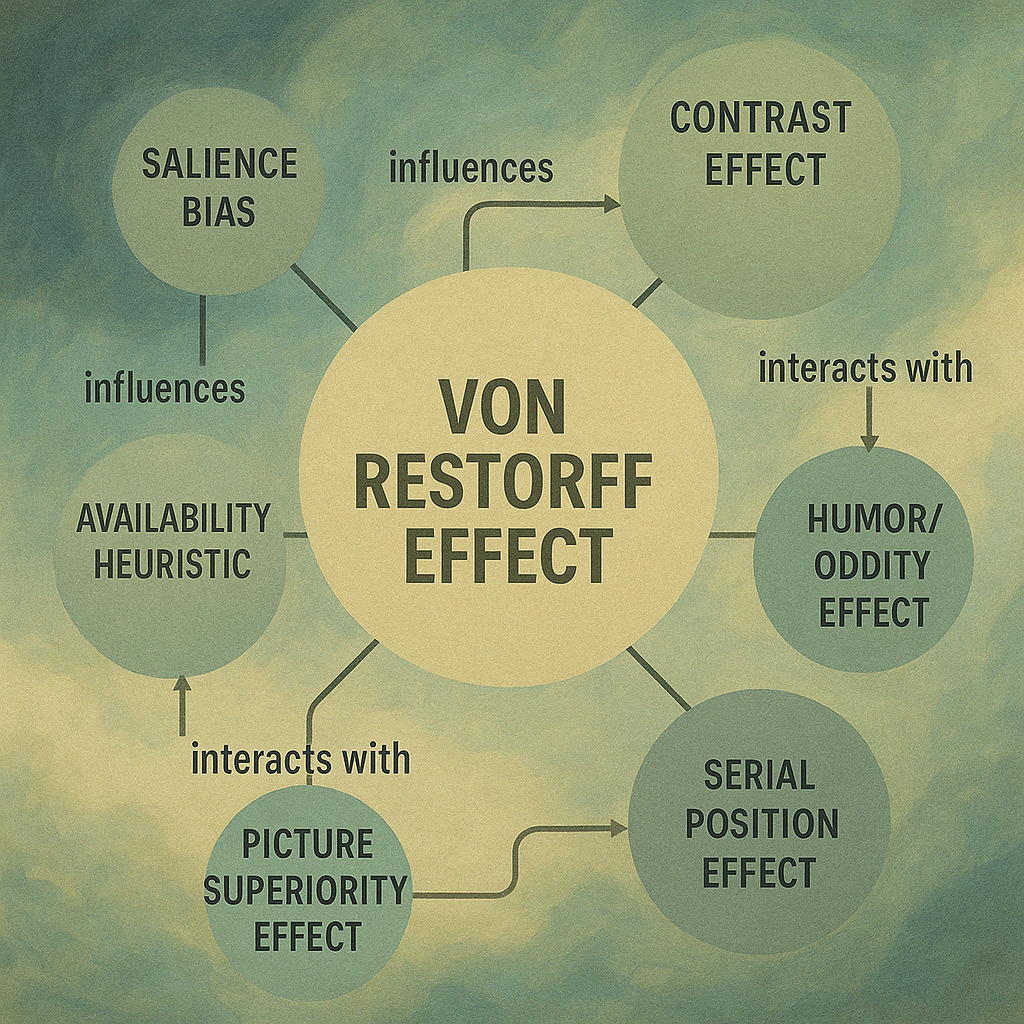
The Von Restorff effect doesn't operate in a cognitive vacuum. It's part of a larger family of mental shortcuts (heuristics) and systematic patterns of thought (biases) that influence how we perceive, remember, and decide. Understanding its relationship with these "cognitive cousins" provides a richer picture of how our minds handle information, particularly when faced with novelty or contrast. Cognitive biases rarely work in isolation; they often interact to shape our judgments.[111]
One of the closest relatives is Salience Bias. This is the general tendency to focus on information that is more prominent, emotionally striking, or easily noticeable, while ignoring less remarkable information, even if the latter is objectively more important.[103] The Von Restorff effect can be seen as a specific manifestation of salience bias, focusing particularly on how salience achieved through distinctiveness within a set leads to enhanced memory.[112] While all Von Restorff isolates are salient, not all salient stimuli necessarily produce a long-term Von Restorff memory effect; salience might just capture immediate attention.
The Von Restorff effect directly feeds into the Availability Heuristic.[95] This heuristic describes our tendency to judge the likelihood or frequency of events based on how easily examples come to mind. Because the Von Restorff effect makes distinctive or unusual items exceptionally memorable, these items become highly available in our memory. Consequently, we might overestimate how often such distinctive events occur. For instance, vividly remembering a single, unusual instance of a product failure (made memorable by its distinctiveness) might lead us, via the availability heuristic, to overestimate the product's overall failure rate.[114]
The Bizarreness Effect and the Humor Effect are often considered specific types or close relatives of the Von Restorff effect.[14] Both rely on conceptual distinctiveness. Bizarre items (like a purple cow) or humorous items stand out from the mundane, capturing attention and leading to better recall.[35] Humor adds an emotional layer, which can further strengthen memory encoding.[61] However, like the general Von Restorff effect, overuse can diminish the impact (if everything is bizarre, nothing is) [35], and relevance is key—humor that distracts might harm comprehension.[61]
The Contrast Effect (or Contrast Principle) is related but distinct.[119] It describes how our perception or judgment of something is influenced by immediate comparison with something else presented sequentially or simultaneously.[120] For example, lifting a heavy weight makes a subsequent lighter weight feel even lighter. While Von Restorff focuses on the enhanced memory of an isolate within a set of similar items, the Contrast Effect focuses on the altered perception or evaluation based on comparison, often between just two items or against a recent standard. There's overlap in that difference matters, but the primary outcome differs (memory recall vs. perceptual judgment). However, they can work together; highlighting a "recommended" subscription tier [90] uses Von Restorff to make it memorable, and might use the Contrast Effect (if positioned next to a much more expensive or clearly inferior 'decoy' option) to make it seem like a better value.
The Picture Superiority Effect notes that pictures and images are generally remembered better than words.[20] This can interact with the Von Restorff effect. Using a unique, distinctive image within a block of text or alongside other, more uniform images leverages both principles: the image itself is inherently more memorable (Picture Superiority), and its uniqueness within the context enhances this further (Von Restorff).[36]
Finally, the Serial Position Effect describes the tendency to better remember items at the beginning (primacy effect) and end (recency effect) of a list, compared to items in the middle.[12] The Von Restorff effect can override this typical U-shaped recall curve. A distinctive item placed in the middle of a list is often remembered much better than its non-distinctive neighbors, creating a spike in recall where memory would typically dip.[60]
Understanding these relationships helps clarify the specific role of the Von Restorff effect – it's primarily about enhancing memory through distinctiveness within a homogeneous context. Recognizing how it interacts with other biases like Availability or can be achieved through specific means like humor or imagery provides a more nuanced toolkit for communication and decision-making.
Table 1: Cognitive Cousins: Understanding Distinctiveness Effects
Bias Name | Core Idea | How it Relates to Von Restorff |
Von Restorff Effect | Distinctive items within a homogeneous set are better remembered. | The primary focus of this article; enhanced memory due to isolation/difference. |
Salience Bias | Tendency to focus on prominent or emotionally striking items, ignoring unremarkable ones. | Von Restorff is often considered a specific type of salience effect focused on memory enhancement due to distinctiveness within a defined context. |
Availability Heuristic | Judging likelihood based on how easily examples come to mind. | Von Restorff makes distinctive items highly memorable, thus increasing their mental availability and potentially skewing frequency/importance judgments. |
Bizarreness/Humor Effect | Bizarre or humorous items are better remembered than common/non-humorous ones. | Often seen as specific instances of Von Restorff, relying on conceptual distinctiveness (oddity, amusement) to enhance memory. |
Contrast Effect | Perception/judgment of something is influenced by immediate comparison with something else. | Related through the importance of difference, but focuses on perception/judgment based on comparison, not necessarily memory of an isolate in a set. |
Picture Superiority Effect | Pictures are generally remembered better than words. | Can work synergistically: a distinctive picture benefits from both effects. Distinctiveness enhances the inherent memorability of visual information. |
Serial Position Effect | Better recall for items at the beginning (primacy) and end (recency) of a list. | Von Restorff can override this: a distinctive item in the middle of a list can be recalled better than typical middle items, disrupting the U-curve. |
7. Putting It to Work: Practical Tips for Professionals
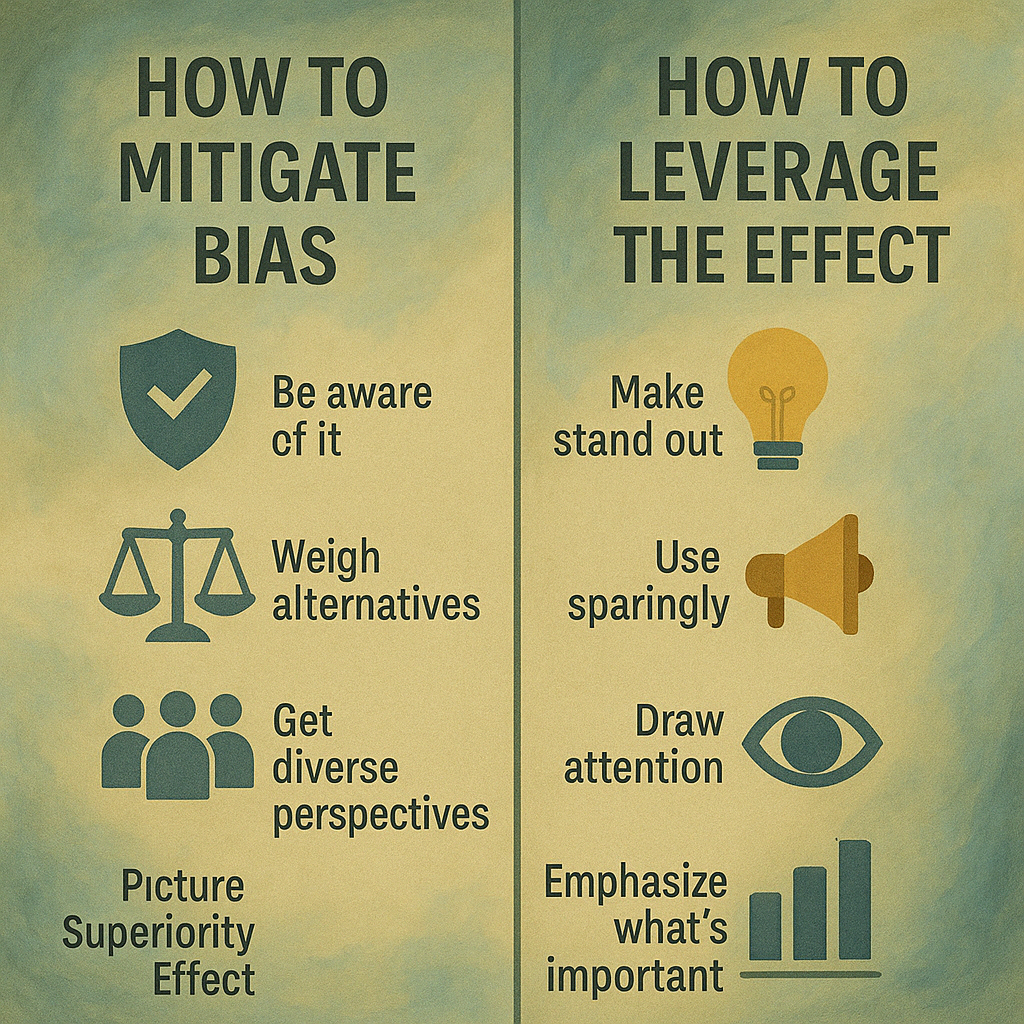
Understanding the Von Restorff effect is one thing; applying that knowledge effectively in a professional context is another. For HR professionals, business leaders, managers, designers, and communicators, this cognitive bias presents both opportunities and challenges. Here are practical strategies to mitigate its potential negative impacts on decision-making and to leverage its power strategically.
Mitigating Bias in Decision-Making (e.g., Hiring, Performance Reviews, Strategy)
Simply being aware of the Von Restorff effect isn't sufficient to counteract its influence on judgment, as cognitive biases often operate unconsciously.[115] Active mitigation strategies are required:
- Acknowledge the Bias: Explicitly recognize that a particularly memorable candidate (due to an unusual skill, background, or even just their interview style), a standout data point in a report, or a uniquely presented proposal might be receiving disproportionate mental weight.[46] Consciously ask: Does its memorability truly reflect its importance or suitability?
- Implement Systematic Evaluation: Use structured frameworks for decisions. In hiring, this means using consistent interview questions and standardized scoring rubrics for all candidates, evaluating them against pre-defined criteria rather than allowing one unique positive or negative aspect to dominate the overall impression.[124] For strategic decisions, ensure all options are assessed against the same set of objective criteria.
- Consider the Whole Picture: Actively fight the tendency to focus only on the "oddball." Make a conscious effort to recall and weigh all relevant information, including the less exciting, more homogeneous data points or candidate qualifications that might otherwise fade into the background.[104] Don't let the vivid exception overshadow the mundane but potentially more representative rule.
- Seek Diverse Perspectives: Discuss important decisions with colleagues who bring different viewpoints, experiences, and potential biases. This can help counterbalance individual tendencies to overvalue distinctive information and provide a more rounded assessment.[106]
- Prioritize Data Over Anecdotes: Base decisions on comprehensive data analysis rather than relying on a single, highly memorable (distinctive) anecdote or case study, which might not be representative of the broader situation.[106]
- Reframe the Options: When comparing choices, try describing or viewing them from different angles. For example, focus on potential losses instead of gains, or group options based on similarities rather than differences. This can help assess whether an option truly stands out on merit or if its perceived distinctiveness is merely an artifact of how it was initially presented.[104]
Strategically Leveraging the Effect (e.g., Communication, Marketing, Design, Training)
When the goal is to make specific information memorable or guide attention effectively, the Von Restorff effect can be a powerful tool, provided it's used thoughtfully:
- Highlight Crucial Information: In reports, presentations, websites, emails, or training materials, use visual distinctiveness sparingly to draw attention to the most critical takeaways, instructions, warnings, or calls-to-action (CTAs). This can involve bolding text, using a contrasting color for a key phrase or button, employing icons or call-out boxes, or strategically using whitespace to isolate an important element.[14]
- Vary Formats: To maintain engagement and create memorable anchor points in longer communications (like training modules or lengthy articles), break the monotony by introducing different formats. Insert a short video clip into a text-heavy section, use an infographic to summarize data, or follow an explanation with an interactive quiz.[16] The shift in format itself creates distinctiveness.
- Use Unique Analogies and Stories: Explain complex or abstract concepts using unexpected but apt metaphors, analogies, or brief stories. A quirky comparison (like a firewall being a nightclub bouncer [16]) can make an idea stick far better than a dry, technical description.[16]
- Emphasize Brand Differentiation: In marketing and strategy, clearly identify what makes your product, service, or organization conceptually unique compared to competitors. Focus communication efforts on highlighting these distinctive assets (unique features, brand colors, logos, taglines, characters, jingles) consistently across all touchpoints to build mental availability.[17]
- Guide Attention in UX Design: Apply contrast principles strategically for CTAs, pricing tables, navigation elements, notifications, and error messages. Ensure the highlighted elements align with user goals and enhance usability. Maintain overall brand consistency and avoid visual clutter.[18]
- Apply Ethically: Always ensure that the element being highlighted provides genuine value or necessary clarity to the audience. Be transparent, especially if highlighting might benefit the business (e.g., a preferred plan). Never use distinctiveness to deceive, manipulate users into unwanted actions, or obscure critical information (like risks or fine print). Prioritize accessibility by providing non-visual cues where necessary.[20]
- Test and Refine: Don't assume that an attempt to create distinctiveness is working as intended or being perceived positively. Test recall, comprehension, and user perception with the target audience through methods like A/B testing, user surveys, or simply asking colleagues for feedback.[16] Adjust the approach based on results.
Effectively navigating the Von Restorff effect requires a dual approach: actively counteracting its potential to bias one's own judgment while thoughtfully and ethically applying its principles to make communication clearer and more memorable for others.
8. Conclusion: The Takeaway That Stands Out
The journey through the Von Restorff effect reveals a fundamental truth about human cognition: our minds are pattern-recognition machines, inherently drawn to, and better at remembering, whatever breaks the mold.[3] This "oddball advantage," where the distinct item in a sea of similarity captures our attention and lodges itself in memory, is a powerful force shaping our experiences and decisions.
We see its influence across countless domains. It's the engine behind memorable advertising campaigns that dare to be different, the principle guiding designers to highlight crucial calls-to-action on a webpage, the reason a unique candidate might stand out in a pile of resumes, and even a factor in how patients recall medical information.[15] Understanding this effect offers professionals a potent tool for enhancing communication, learning, and brand recall.
However, the power of distinctiveness comes with caveats. Overuse dilutes its impact, making nothing stand out. Irrelevant or gimmicky differentiation can distract or annoy rather than inform. Relying solely on visual contrast can create accessibility barriers. And critically, the heightened focus on the isolate can lead to neglecting important background information or, in the wrong hands, be used to manipulate choices unethically. The goal is not simply to be different, but to be meaningfully and positively distinctive.[16]
Ultimately, the Von Restorff effect underscores the importance of contrast and context in how we process the world. It reminds us that effective communication isn't just about the content, but about how that content is presented relative to its surroundings. It calls for a strategic approach—whether mitigating the bias in our own judgments by seeking out the whole picture, or leveraging the effect in our communications by making the truly important information stand out clearly and ethically.
As professionals navigating an increasingly crowded information landscape, the challenge remains:
Now that you recognize the brain's inherent bias for the oddball, where will you start noticing its influence in your daily work—and more importantly, how will you ensure this powerful effect serves to clarify judgment and enhance understanding, rather than merely skewing perception?
Bibliography
- «Think different» : A Campaign That Changed Apple's Destiny - Brandvertising, accessed: April 19, 2025, https://www.brandvertising.ch/2023/03/think-different-apple/
- A quick guide to Apple's Think Different campaign (Updated) - Posterama.co, accessed: April 19, 2025, https://www.posterama.co/blogs/news/13414153-apple-think-different
- Von Restorff Effect - Moresapien, accessed: April 19, 2025, https://moresapien.org/von-restorff-effect/
- Apple's “Think Different” Campaign | Wiki - FreedomGPT, accessed: April 19, 2025, https://www.freedomgpt.com/wiki/apples-think-different-campaign
- Apple's Think Different Campaign - Caseomania, accessed: April 19, 2025, https://www.caseomania.com/post/apple-s-think-different-campaign
- Think different - Wikipedia, accessed: April 19, 2025, https://en.wikipedia.org/wiki/Think_different
- Brand Campaigns, Part 5.3: Did Apple's Brand Advertising Lead to Brand Growth? -, accessed: April 19, 2025, https://www.brandingmag.com/john-james/brand-campaigns-part-5-3-did-apples-brand-advertising-lead-to-brand-growth/
- 9 Epic Consumer Product Design Failures - Onshape, accessed: April 19, 2025, https://www.onshape.com/en/blog/epic-consumer-product-design-failures
- Learning from Failure: 4 Lessons from Famous Product Flops - Norwest Venture Partners, accessed: April 19, 2025, https://www.nvp.com/blog/learning-from-failure-4-lessons-from-famous-product-flops/
- Lessons from Failure: Case Studies of Products That Didn't Make the Cut, accessed: April 19, 2025, https://www.productleadership.com/lessons-from-failure-case-studies-of-products-that-didnt-make-the-cut/
- 20 Product Management Failure Examples [2025] - DigitalDefynd, accessed: April 19, 2025, https://digitaldefynd.com/IQ/product-management-failure-examples/
- Von Restorff effect - Wikipedia, accessed: April 19, 2025, https://en.wikipedia.org/wiki/Von_Restorff_effect
- Von Restorff Effect: Increased Recall of Unique Customer Experiences - Renascence, accessed: April 19, 2025, https://www.renascence.io/journal/von-restorff-effect-increased-recall-of-unique-customer-experiences
- The von Restorff Isolation Effect: What Stands Out Is Remembered Better - Effectiviology, accessed: April 19, 2025, https://effectiviology.com/von-restorff-isolation-effect/
- THE VON RESTORFF EFFECT: UNDERSTANDING HOW "DIFFERENT" MAKES IDEAS STICK | Mya Care, accessed: April 19, 2025, https://myacare.com/blog/the-von-restorff-effect-understanding-how-different-makes-ideas-stick
- The von Restorff Effect: Strategic Design for Better Learning Retention - ThinkyDink, accessed: April 19, 2025, https://www.thinkydink.com/blog/the-von-restorff-effect-strategic-design-for-better-learning-retention
- Using Behavioural Science: The Von Restorff Effect | Blog - Startle, accessed: April 19, 2025, https://www.startlemusic.com/blog/using-behavioural-science-the-von-restorff-effect
- Von Restorff Effect: UX Law of Distinctiveness | UXtweak, accessed: April 19, 2025, https://blog.uxtweak.com/von-restorff-effect/
- Isolation / von Restorff Effect - Contagious, accessed: April 19, 2025, https://www.contagious.com/iq/article/isolation-von-restorff-effect
- Isolation Effect design pattern, accessed: April 19, 2025, https://ui-patterns.com/patterns/isolation-effect
- How the Von Restorff Effect Influences Business Model Strategy and Tech Innovations, accessed: April 19, 2025, https://www.hulkapps.com/blogs/ecommerce-hub/how-the-von-restorff-effect-influences-business-model-strategy-and-tech-innovations
- CHAPTER 8: EYEWITNESS TESTIMONY: MEMORY AND IDENTIFICATION, accessed: April 19, 2025, https://pressbooks.bccampus.ca/psyc268/chapter/chapter-8/
- The Weapon Focus Effect for Person Identifications and Descriptions: A Meta-analysis, accessed: April 19, 2025, https://www.researchgate.net/publication/303823339_The_Weapon_Focus_Effect_for_Person_Identifications_and_Descriptions_A_Meta-analysis
- thebehavioursagency.com, accessed: April 19, 2025, https://thebehavioursagency.com/latest/the-von-restorff-effect#:~:text=What%20is%20the%20Von%20Restorff,ll%20remember%20the%20red%20one.
- Von Restorff Effect - The Behaviours Agency, accessed: April 19, 2025, https://thebehavioursagency.com/latest/the-von-restorff-effect
- Understanding Behavioural Science - Von Restorff Effect | Blog - Startle, accessed: April 19, 2025, https://www.startlemusic.com/blog/understanding-behavioural-science-von-restorff-effect
- learningloop.io, accessed: April 19, 2025, https://learningloop.io/plays/psychology/isolation-effect#:~:text=The%20Isolation%20Effect%2C%20also%20known,blend%20in%20with%20their%20surroundings.
- The subtlety of distinctiveness: What von Restorff really did - PubMed, accessed: April 19, 2025, https://pubmed.ncbi.nlm.nih.gov/24203592/
- A Marketer Must-Read: Using Behavioral Science in Marketing by Nancy Harhut | Sagefrog, accessed: April 19, 2025, https://www.sagefrog.com/blog/a-marketer-must-read-using-behavioral-science-in-marketing-by-nancy-harhut/
- Serial position effect | EBSCO Research Starters, accessed: April 19, 2025, https://www.ebsco.com/research-starters/psychology/serial-position-effect
- The Nutter Butter campaign explained. Yes, this nightmare makes sense - Schaefer Marketing Solutions: We Help Businesses {grow}, accessed: April 19, 2025, https://businessesgrow.com/2024/10/07/nutter-butter/
- Von Restorff Effect—A Psychological Impact of the Customers - ResearchGate, accessed: April 19, 2025, https://www.researchgate.net/publication/385493315_Von_Restorff_Effect-A_Psychological_Impact_of_the_Customers
- Use the 'Von Restorff Effect' When Studying Difficult Concepts - Lifehacker, accessed: April 19, 2025, https://lifehacker.com/how-to-use-von-resteroff-effect-when-studying-1850921998
- Review of the historical, empirical, and theoretical status of the von Restorff phenomenon, accessed: April 19, 2025, https://www.researchgate.net/publication/9270310_Review_of_the_historical_empirical_and_theoretical_status_of_the_von_Restorff_phenomenon
- Bizarreness Effect - The Behavioral Scientist, accessed: April 19, 2025, https://www.thebehavioralscientist.com/glossary/bizarreness-effect
- Why Do Mnemonics Work? It's Science. - Picmonic, accessed: April 19, 2025, https://www.picmonic.com/pages/why-do-mnemonics-work-its-science/
- How to use the Von Restorff effect to increase your sales? - SiteW, accessed: April 19, 2025, https://www.en.sitew.com/How-to-grow-your-online-business/Von-Restorff-effect-to-increase-sales
- The Von Restorff Effect ~ Making things stand-out from the background, accessed: April 19, 2025, https://destech.wordpress.com/about-2/the-von-restorff-effect-making-things-stand-out-from-the-background/
- Does the isolation effect remain relevant today? - Strategy, accessed: April 19, 2025, https://strategyonline.ca/2018/10/16/does-the-isolation-effect-remain-relevant-today/
- 4 Common Behavioral Biases That Influence Customer Decisions in Marketing - Khepresh, accessed: April 19, 2025, https://khepresh.com/blog/25/4-Common-Behavioral-Biases-That-Influence-Customer-Decisions-in-Marketing
- Synesthesia and Memory: Color Congruency, von Restorff, and False Memory Effects, accessed: April 19, 2025, https://www.researchgate.net/publication/49764167_Synesthesia_and_Memory_Color_Congruency_von_Restorff_and_False_Memory_Effects
- 42 Effects You Should Know: Part 2 — 42courses.com, accessed: April 19, 2025, https://www.42courses.com/blog/home/2022/9/2/42-effects-you-should-know-part-2
- How cognitive psychology can improve your user's experience - Standard Beagle, accessed: April 19, 2025, https://standardbeagle.com/how-cognitive-psychology-can-improve-ux/
- Psychology in Design - itmtb, accessed: April 19, 2025, https://www.itmtb.com/blog/psychology-in-design
- Von Restorff Effect - Think360 Studio, accessed: April 19, 2025, https://think360studio.com/blog/von-restorff-effect
- What Is the Isolation Effect? - Critical Thinking, accessed: April 19, 2025, https://www.howtogetyourownway.com/effects/isolation_effect.html
- Distinctiveness in Psychology: Definition, Theories, and Applications - NeuroLaunch.com, accessed: April 19, 2025, https://neurolaunch.com/distinctiveness-psychology-definition/
- CogBlog – A Cognitive Psychology Blog » You will remember this post. Why? Because it is weird! - The Colby College Community Web, accessed: April 19, 2025, https://web.colby.edu/cogblog/2017/04/20/45ds678giqrwfdg/
- Distinctiveness effect due to contextual information in a categorization task, accessed: April 19, 2025, https://journals.openedition.org/cpl/4975
- The Von Restorff Effect: Understanding Memory Through, accessed: April 19, 2025, https://www.bartleby.com/docs/psychology/627464
- Concord McNair Scholars Research Journal, accessed: April 19, 2025, https://www.concord.edu/wp-content/uploads/Volume-20-McNair-Research-Journal.pdf
- Linking Seductive Details and the Isolation Effect - Journals, accessed: April 19, 2025, https://journals.charlotte.edu/ujop/article/view/410/645
- Hedwig von Restorff - Wikipedia, accessed: April 19, 2025, https://en.wikipedia.org/wiki/Hedwig_von_Restorff
- The subtlety of distinctiveness: What von Restorff really did - ResearchGate, accessed: April 19, 2025, https://www.researchgate.net/publication/258350014_The_subtlety_of_distinctiveness_What_von_Restorff_really_did
- Owais Mufti.docx, accessed: April 19, 2025, https://gatton.uky.edu/sites/default/files/parkistan-project/Owais%20Mufti.docx
- Von Restorff Revisited: Isolation, Generation, and Memory for Order - ResearchGate, accessed: April 19, 2025, https://www.researchgate.net/publication/12127312_Von_Restorff_Revisited_Isolation_Generation_and_Memory_for_Order
- The Von Restorff Effect in UX Design - Radiant Digital, accessed: April 19, 2025, https://www.radiant.digital/the-von-restorff-effect-in-ux-design/
- Proportion of responses for isolates and controls (7th position) by output position. - ResearchGate, accessed: April 19, 2025, https://www.researchgate.net/figure/Proportion-of-responses-for-isolates-and-controls-7th-position-by-output-position_fig2_5948864
- Von Restorff Effect in UX Design | GeeksforGeeks, accessed: April 19, 2025, https://www.geeksforgeeks.org/von-restorff-effect-in-ux-design/
- The Von Restorff effect in the Brazilian version of the Rey Auditory Verbal Learning Test in an elderly population, accessed: April 19, 2025, https://pmc.ncbi.nlm.nih.gov/articles/PMC6497024/
- Humor Effect - The Behavioral Scientist, accessed: April 19, 2025, https://www.thebehavioralscientist.com/glossary/humor-effect
- A context-change account of temporal distinctiveness - UVA Computational Memory Lab, accessed: April 19, 2025, https://compmem.org/assets/pdf/Siefke.etal.2019.pdf
- Electrophysiological analysis of the role of novelty in the von Restorff effect - PMC, accessed: April 19, 2025, https://pmc.ncbi.nlm.nih.gov/articles/PMC3607156/
- Von Restorff Revisited: Isolation, Generation, and Memory for Order - ResearchGate, accessed: April 19, 2025, https://www.researchgate.net/publication/298967778_Von_Restorff_Revisited_Isolation_Generation_and_Memory_for_Order
- What Causes the Isolation Effect? - ResearchGate, accessed: April 19, 2025, https://www.researchgate.net/publication/11641182_What_Causes_the_Isolation_Effect
- Providing Support for Distinctive Processing: The Isolation Effect in Young and Older Adults, accessed: April 19, 2025, https://pmc.ncbi.nlm.nih.gov/articles/PMC3183572/
- (PDF) Cognitive Biases and Their Influence on Critical Thinking and Scientific Reasoning: A Practical Guide for Students and Teachers - ResearchGate, accessed: April 19, 2025, https://www.researchgate.net/publication/316486755_Cognitive_Biases_and_Their_Influence_on_Critical_Thinking_and_Scientific_Reasoning_A_Practical_Guide_for_Students_and_Teachers
- Salient objects in a scene trigger enhanced perceptual selection and memory encoding, accessed: April 19, 2025, https://www.biorxiv.org/content/10.1101/2025.03.25.645146v1.full-text
- Inattentional blindness and the von Restorff effect - ResearchGate, accessed: April 19, 2025, https://www.researchgate.net/publication/265175233_Inattentional_blindness_and_the_von_Restorff_effect
- (PDF) Attention and the von Restorff effect - ResearchGate, accessed: April 19, 2025, https://www.researchgate.net/publication/230099938_Attention_and_the_von_Restorff_effect
- Full article: The Effect of Highlighting on Cognitive Load and Visual Attention in Multimedia Learning - Taylor and Francis, accessed: April 19, 2025, https://www.tandfonline.com/doi/full/10.1080/10447318.2025.2478274?src=
- Knowledge Is Power: Prior Knowledge Aids Memory for Both Congruent and Incongruent Events, but in Different Ways - PubMed Central, accessed: April 19, 2025, https://pmc.ncbi.nlm.nih.gov/articles/PMC6390882/
- Von Restorff Effect Research Articles - R Discovery, accessed: April 19, 2025, https://discovery.researcher.life/topic/von-restorff-effect/25860541?page=1&topic_name=Von%20Restorff%20Effect
- The role of the frontal cortex in memory: an investigation of the Von Restorff effect - PMC, accessed: April 19, 2025, https://pmc.ncbi.nlm.nih.gov/articles/PMC4073090/
- Encoding Processes and Memory Organization: A Model of the von Restorff Effect | Request PDF - ResearchGate, accessed: April 19, 2025, https://www.researchgate.net/publication/15321999_Encoding_Processes_and_Memory_Organization_A_Model_of_the_von_Restorff_Effect
- Revisiting von Restorff's early isolation effect - OUCI, accessed: April 19, 2025, https://ouci.dntb.gov.ua/works/7PgYdnG9/
- The distinctiveness effect in the absence of conscious recollection: Evidence from conceptual priming - Social Memory and Cognition Lab, accessed: April 19, 2025, https://rajarammemorylab.com/wp-content/uploads/2015/08/12-tqdinc.pdf
- Revisiting von Restorff's early isolation effect - OUCI, accessed: April 19, 2025, https://ouci.dntb.gov.ua/en/works/7PgYdnG9/
- What explains the von Restorff effect? Contrasting distinctive processing and retrieval cue efficacy | Request PDF - ResearchGate, accessed: April 19, 2025, https://www.researchgate.net/publication/324139224_What_explains_the_von_Restorff_effect_Contrasting_distinctive_processing_and_retrieval_cue_efficacy
- Revisiting von Restorff's early isolation effect | Request PDF - ResearchGate, accessed: April 19, 2025, https://www.researchgate.net/publication/308173712_Revisiting_von_Restorff's_early_isolation_effect
- Electrophysiological analysis of the role of novelty in the von Restorff effect - PubMed, accessed: April 19, 2025, https://pubmed.ncbi.nlm.nih.gov/23531713/
- Memory recall in arousing situations – an emotional von Restorff effect? - PubMed Central, accessed: April 19, 2025, https://pmc.ncbi.nlm.nih.gov/articles/PMC1552077/
- Liquid Death & the Value of Unconventional Marketing - PostNet, accessed: April 19, 2025, https://www.postnet.com/blog/liquid-death-brand-development-value-of-unconventional-marketing/
- Liquid Death's audacious marketing reshapes bottled water market - DMNews, accessed: April 19, 2025, https://dmnews.com/liquid-deaths-audacious-marketing-reshapes-bottled-water-market/
- Liquid Death's Marketing Strategy Winning Over Consumers - MetricsCart, accessed: April 19, 2025, https://metricscart.com/insights/liquid-death-marketing-strategy/
- Analyzing Liquid Deaths Competitive Edge - Osum, accessed: April 19, 2025, https://blog.osum.com/liquid-death-competitive-analysis/
- Murdering a market with daring distinctiveness: Liquid Death - the brandgym, accessed: April 19, 2025, https://thebrandgym.com/mudering-a-market-with-daring-distinctiveness-liquid-death/
- The Killer Marketing Strategy of Liquid Death - Keegan Edwards, accessed: April 19, 2025, https://keeganedwards.com/the-killer-marketing-strategy-of-liquid-death/
- Liquid Death revenue, valuation & growth rate | Sacra, accessed: April 19, 2025, https://sacra.com/c/liquid-death/
- The Power of Perception: Behavioural Economics in Digital Media - FT Strategies, accessed: April 19, 2025, https://www.ftstrategies.com/en-gb/insights/the-power-of-perception-behavioural-economics-in-digital-media
- Design Psychology: The Von Restorff Effect - Leggett & Platt Marketing + Creative, accessed: April 19, 2025, https://lpmarketingcreative.com/topics/marketing/design-psychology-the-von-restorff-effect
- The Von Restorff Effect: Why Good UX Stands Out - Fyresite, accessed: April 19, 2025, https://www.fyresite.com/the-von-restorff-effect-why-good-ux-stands-out/
- Does the Von Restorff Effect Influence User Preference? - MeasuringU, accessed: April 19, 2025, https://measuringu.com/von-restorff/
- The Von Restorff Effect in UX Design | SERP WIZARD, accessed: April 19, 2025, https://www.serpwizard.com/the-von-restorff-effect-in-ux-design/
- The Psychology of UX: How Cognitive Science Influences Design - Capital Numbers, accessed: April 19, 2025, https://www.capitalnumbers.com/blog/psychology-of-ux-how-cognitive-science-influences-design/
- Von Restorff Effect Marketing - Smith, accessed: April 19, 2025, https://smith.co.uk/the-von-restorff-effect/
- The Von Restorff Effect - Don't blend in; stand out - Graham Baker Photography, accessed: April 19, 2025, https://www.grahambakerphotography.com/article/von-restorff-effect/
- Unveiling Case Studies Of Successful Brand Differentiation - Wizard Marketing, accessed: April 19, 2025, https://thewizard.marketing/unveiling-case-studies-of-successful-brand-differentiation/
- Top 5 Global Branding Case Studies and Their Strategies - Cretesol Tech, accessed: April 19, 2025, https://cretesoltech.com/global-branding-case-studies/
- The Von Restorff effect in ageing and Alzheimer's disease | Request PDF - ResearchGate, accessed: April 19, 2025, https://www.researchgate.net/publication/6888812_The_Von_Restorff_effect_in_ageing_and_Alzheimer's_disease
- Von Restorff Effect - Coglode, accessed: April 19, 2025, https://www.coglode.com/research/von-restorff-effect
- Von Restorff Effect - Laws of UX, accessed: April 19, 2025, https://lawsofux.com/von-restorff-effect/
- Isolation Effect - Learning Loop, accessed: April 19, 2025, https://learningloop.io/plays/psychology/isolation-effect
- Video: Prospect Theory: Isolation Effect - Concept - JoVE, accessed: April 19, 2025, https://www.jove.com/business-education/17690/prospect-theory-isolation-effect
- Cognitive Bias And Marketing: How Our Minds Influence Purchasing - Emulent, accessed: April 19, 2025, https://emulent.com/blog/cognitive-biases-and-marketing/
- 16 cognitive biases that can kill your decision making - Business Ethics Resource Center, accessed: April 19, 2025, https://www.businessethicsresourcecenter.org/16-cognitive-biases-that-can-kill-your-decision-making/
- How Might Businesses Use Cognitive Biases To Their Advantage? - Agile Digital Agency, accessed: April 19, 2025, https://www.agiledigitalagency.com/blog/cognitive-biases-business-advantage/
- To Avoid Unethical Decisions, Be Aware of Sneaky Cognitive Biases | Cutter Consortium, accessed: April 19, 2025, https://www.cutter.com/article/understanding-cognitive-biases-can-sneak-our-decisions-lead-advisor
- The psychology behind email engagement and why it works | Okoone, accessed: April 19, 2025, https://www.okoone.com/spark/marketing-growth/the-psychology-behind-email-engagement-and-why-it-works/
- Psychology of UX: Crafting Intuitive Digital Experiences - Hire Developer, accessed: April 19, 2025, https://hiredeveloper.dev/psychology-of-ux-in-digital-experiences/6022
- The Impact of Cognitive Biases on Corporate Decision-Making: Analysis and Mitigation Strategies - SHS Web of Conferences, accessed: April 19, 2025, https://www.shs-conferences.org/articles/shsconf/pdf/2024/27/shsconf_icdeba2024_04007.pdf
- List of cognitive biases - Wikipedia, accessed: April 19, 2025, https://en.wikipedia.org/wiki/List_of_cognitive_biases
- Philosodata: Cognitive Biases and Fallacies - Gained InSite: facts that destroy postmodernism, accessed: April 19, 2025, https://gainedin.site/bias/
- 3 Things Everyone Should Know About the Availability Heuristic, accessed: April 19, 2025, https://fs.blog/mental-model-availability-bias/
- Identify Cognitive Biases in Business Decision-Making - Mailchimp, accessed: April 19, 2025, https://mailchimp.com/resources/what-is-cognitive-bias/
- The Impact of Cognitive Biases on Decision-Making in Dentistry - Spear Education, accessed: April 19, 2025, https://www.speareducation.com/spear-review/2025/02/impact-of-cognitivie-biases-on-decision-making-in-dentistry
- Memory Distortions - Understanding and Overcoming Hate, accessed: April 19, 2025, https://www.overcominghateportal.org/memory-distortions.html
- 3. Too Much Info - Cognitive Bias Foundation - transhumanity.net, accessed: April 19, 2025, http://bias.transhumanity.net/too-much-info/
- Design Psychology: Principles and Concepts to Empower Your Projects | Blush Blog, accessed: April 19, 2025, https://blush.design/blog/post/design-psychology
- Contrast Principle definition - Convertize A/B Testing Ideas, accessed: April 19, 2025, https://tactics.convertize.com/definitions/contrast-principle
- Picture Superiority Effect - Renascence, accessed: April 19, 2025, https://www.renascence.io/behavioral-biases/picture-superiority-effect
- Full article: Primacy (and recency) effects in delayed recognition of items from instances of repeated events, accessed: April 19, 2025, https://www.tandfonline.com/doi/full/10.1080/09658211.2024.2354764
- Six cognitive biases that affect your leadership - Australian Institute of Business, accessed: April 19, 2025, https://www.aib.edu.au/blog/leadership/six-cognitive-biases-that-affect-your-leadership/
- Cognitive Biases | MeVitae Blog, accessed: April 19, 2025, https://www.mevitae.com/blog/cognitive-biases
- How Cognitive Bias Affects Your Business - Investopedia, accessed: April 19, 2025, https://www.investopedia.com/articles/investing/022015/how-cognitive-bias-affects-your-business.asp
- Make Your Ideas Stick with The Von Restorff Effect - Decklaration, accessed: April 19, 2025, https://decklaration.com/2019-1-31-make-your-ideas-stick-with-the-von-restorff-effect/
- Highly creative ads are four times more profitable than low creative quality ads - BBN, accessed: April 19, 2025, https://bbn-international.com/2024/10/17/creative-advertising-b2b-marketing-warcs-insights/
- Improving Advertising Effectiveness Using Distinctive Brand Assets, accessed: April 19, 2025, https://www.distinctivebat.com/blog/improving-advertising-effectiveness-using-distinctive-brand-assets/
- The 3 Laws of Persuasion That Always Win (Von Restorff Effect) - Angelo Magno, accessed: April 19, 2025, https://angelomagno.com/blog/von-restorff-effect